


€ 215,00 Gratis verzending

Uitgelicht
|
|
215,00 |
Naar shop
|

|
234,15 |
Naar shop
|

|
234,15 |
Naar shop
|
| VERGELIJK ALLE AANBIEDERS (3) | ||
 Beschrijving
Vergelijk aanbieders (3)
€ 215,00 Gratis verzending
€ 234,15 Gratis verzending
€ 234,15 Gratis verzending
Winkels met andere maten
Beschrijving
(1)
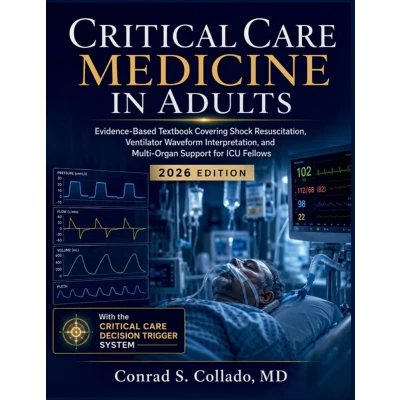
Read the Signal, Fire the Response, Change the TrajectoryBuilt for the intensivist who must translate a bedside signal into a definitive action before the next hour costs the patient, this reference connects the physiology of critical illness - oxygen delivery, the delivery-dependent state, the Frank-Starling balance, the alveolar-capillary interface - to the specific decisions made at three in the morning in the intensive care unit. It moves from the mechanics of hemodynamics, gas exchange, and acid-base balance through the shock states, respiratory failure, multi-organ dysfunction, sepsis, trauma, and post-arrest care, into the humanistic close of the critical illness encounter.The Critical Care Decision Trigger System - a five-part callout embedded in every chapter and consolidated in the back-of-book Master Atlas - codifies the intensivist's core cognitive move into a repeated framework the reader applies under acute cognitive load.What This Book Puts in Your Hands- Classify undifferentiated shock at the bedside - RUSH-informed cardiac, IVC, and lung ultrasound integrated with invasive monitoring to name the mechanism within thirty minutes.- Read the ventilator screen - driving pressure, plateau pressure, and waveform-based dyssynchrony recognition for the ARDS lung, the obstructive lung, and the injured brain.- Escalate the failing ARDS patient - Berlin severity stratification, prone positioning per PROSEVA, and VV-ECMO timing per EOLIA and its Bayesian re-analysis.- Execute the sepsis one-hour bundle - 2026 Surviving Sepsis Campaign vasoactive selection, adjunctive corticosteroids, angiotensin II, and source-control timing that shortens mortality by the hour.- Manage the refractory cardiogenic patient - SCAI staging with Impella and VA-ECMO deployment before rather than after arrest, coordinated through the shock team.- Apply the tiered ICP algorithm and the multimodal post-arrest prognostication that avoids self-fulfilling prophecy in the first seventy-two hours.- Recognize the silent acute abdomen in the intubated sedated patient where acalculous cholecystitis and mesenteric ischemia declare only through rising lactate.- Close the encounter humanistically - A2F ICU Liberation Bundle, CAM-ICU delirium screening, structured family communication, and the transition to comfort-focused care as redirection rather than withdrawal.Open it before your next admission - the decisions every critically ill adult depends on, in one reference.
 Prijshistorie
 * Prijshistorie bevat geen data van Amazon, Amazon Marketplace.
Prijzen voor het laatst bijgewerkt op:
 Gerelateerde resultaten
 Productspecificaties


