
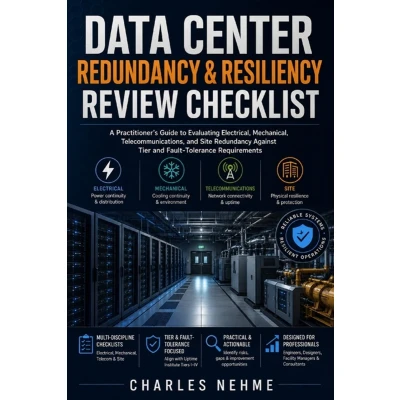
DATA CENTER REDUNDANCY & RESILIENCY REVIEW CHECKLIST: A Practitioner's Guide to Evaluating Electrical, Mechanical, Telecommunications, and SiteRedundancy Against Tier Fault-Tolerance Requirements
Uitgelicht

|
42,99 |
Naar shop
|

|
46,40 |
Naar shop
|

|
46,40 |
Naar shop
|
| VERGELIJK ALLE AANBIEDERS (3) | ||
 Beschrijving
Bol
This checklist-based reference is designed to support structured, repeatable reviews of redundancy and resiliency provisions across a data center's critical infrastructure. It is intended for use during design review, commissioning, due diligence assessments, and periodic operational audits.Redundancy is not a single attribute of a facility - it is a set of independent design decisions made across electrical distribution, mechanical cooling, fire and life safety systems, telecommunications pathways, and the physical site itself. A facility can be highly redundant in one discipline and critically exposed in another. This guide treats each discipline as its own review domain while providing a consolidated framework for rolling findings up into a single facility-level resiliency posture.Each chapter follows the same structure used throughout this series: - A short technical primer on the redundancy concept being reviewed- A RAG-coded (Red/Amber/Green) checklist tied to referenced standards- Discussion of common failure modes and single points of failure (SPOFs)- Cross-references to the FMEA, scoring, and lifecycle cost frameworks in later chaptersRAG status definitions used throughout this guide: GREEN - meets or exceeds the target redundancy configuration with verified fault tolerance. AMBER - nominally compliant but with an identified gap, single-threaded dependency, or unverified failover. RED - does not meet the stated redundancy target, or a critical SPOF has been identified.How to Use This ChecklistThis guide is written to be used non-linearly. A design reviewer evaluating a new build will typically work front-to-back, chapter by chapter, against construction documents and sequence of operations narratives. A commissioning agent or operations team auditing an existing facility will more often jump directly to the relevant discipline chapter and use the SPOF and testing chapters as a supplement.Every checklist item includes a standard or reference where one exists. Where no external standard directly applies, the item reflects accepted industry practice as documented in Uptime Institute Tier Standard guidance and common owner's project requirements (OPR) language.This guide is a review and audit tool. It does not replace a licensed engineer's stamped design, a formal Reliability, Availability, and Maintainability (RAM) analysis, or a third-party Tier Certification. Use it to structure and document a review - not as a substitute for engineering judgment. Charles Nehme HVAC Consultant https: //bit.ly/m/HVAC


 Beschrijving
(1)
Beschrijving
(1)
This checklist-based reference is designed to support structured, repeatable reviews of redundancy and resiliency provisions across a data center's critical infrastructure. It is intended for use during design review, commissioning, due diligence assessments, and periodic operational audits.Redundancy is not a single attribute of a facility - it is a set of independent design decisions made across electrical distribution, mechanical cooling, fire and life safety systems, telecommunications pathways, and the physical site itself. A facility can be highly redundant in one discipline and critically exposed in another. This guide treats each discipline as its own review domain while providing a consolidated framework for rolling findings up into a single facility-level resiliency posture.Each chapter follows the same structure used throughout this series: - A short technical primer on the redundancy concept being reviewed- A RAG-coded (Red/Amber/Green) checklist tied to referenced standards- Discussion of common failure modes and single points of failure (SPOFs)- Cross-references to the FMEA, scoring, and lifecycle cost frameworks in later chaptersRAG status definitions used throughout this guide: GREEN - meets or exceeds the target redundancy configuration with verified fault tolerance. AMBER - nominally compliant but with an identified gap, single-threaded dependency, or unverified failover. RED - does not meet the stated redundancy target, or a critical SPOF has been identified.How to Use This ChecklistThis guide is written to be used non-linearly. A design reviewer evaluating a new build will typically work front-to-back, chapter by chapter, against construction documents and sequence of operations narratives. A commissioning agent or operations team auditing an existing facility will more often jump directly to the relevant discipline chapter and use the SPOF and testing chapters as a supplement.Every checklist item includes a standard or reference where one exists. Where no external standard directly applies, the item reflects accepted industry practice as documented in Uptime Institute Tier Standard guidance and common owner's project requirements (OPR) language.This guide is a review and audit tool. It does not replace a licensed engineer's stamped design, a formal Reliability, Availability, and Maintainability (RAM) analysis, or a third-party Tier Certification. Use it to structure and document a review - not as a substitute for engineering judgment. Charles Nehme HVAC Consultant https: //bit.ly/m/HVAC
 Productspecificaties
 Prijshistorie
* Prijshistorie bevat geen data van Amazon, Amazon Marketplace.
Prijzen voor het laatst bijgewerkt op:
 Gerelateerde resultaten


