


€ 55,65 Gratis verzending

Uitgelicht
|
|
55,65 |
Naar shop
|

|
63,38 |
Naar shop
|

|
63,38 |
Naar shop
|
| VERGELIJK ALLE AANBIEDERS (3) | ||
 Beschrijving
Vergelijk aanbieders (3)
€ 55,65 Gratis verzending
€ 63,38 Gratis verzending
€ 63,38 Gratis verzending
Winkels met andere maten
Beschrijving
(1)
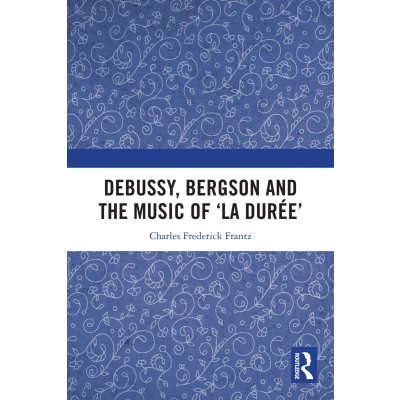
Charles Frantz provides a quantitative and qualitative analysis of Debussy’s music through the lens of Bergson’s philosophical perspective of durée, revealing his ‘revolution’ in musical time. Charles Frederick Frantz provides a quantitative and qualitative analysis of Debussy’s music through the lens of Bergson’s philosophical perspective of durée, revealing his "revolution" in musical time. In fin-de-siècle Paris, Debussy was revolutionizing musical time while Bergson was establishing a metaphysics that challenged the notion of measured or spatialized time. Bergson argued that real time or durée could be grasped only through intuition as opposed to analysis. Debussy eschewed analysis of music, declaring that separating it into parts was better left to engineers. Debussy’s music and Bergson’s durée were conceived and imagined in the environs of nature. The cycle of seasons, the gracefulness of a blooming flower, or a gentle breeze all suggest continuity, flow, and uninterrupted rhythm. The time of nature is the time of Debussy’s music and Bergson’s durée. Debussy’s use of open forms and Golden Sections create a time world of an expanded present, never ceasing. Bergson’s perception of real time is ever-changing, bringing the past into the present and open to unforeseen novelty. This book is intended primarily for scholars in the disciplines of musicology, music theory, and philosophy and can be used as a text for upper-level undergraduate or graduate courses in musicology or music theory.
 Prijshistorie
 * Prijshistorie bevat geen data van Amazon, Amazon Marketplace.
Prijzen voor het laatst bijgewerkt op:
 Gerelateerde resultaten
 Productspecificaties


