
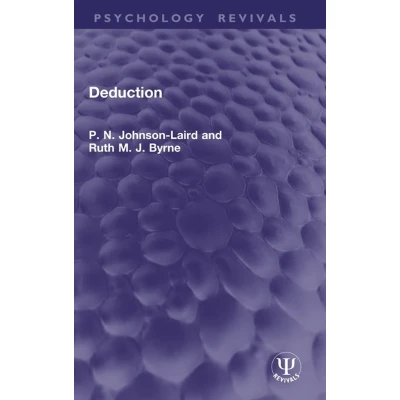
Deduction
Uitgelicht

|
115,00 |
Naar shop
|

|
115,98 |
Naar shop
|

|
115,98 |
Naar shop
|
| VERGELIJK ALLE AANBIEDERS (3) | ||
 Beschrijving
Bol
How do people make deductions? The orthodox answer is that they follow formal rules of inference. First published in 1991, the authors of this book repudiate this theory. Arguing that people reason by building a model of the state of affairs, formulating a conclusion based on this model, and searching for alternative models that refute it. How do people make deductions? The orthodox answer is that they follow formal rules of inference. Originally published in 1991, and reissued here with a new preface, the authors of Deduction repudiate this theory. They argue that people reason by building a model of the state of affairs, formulating a conclusion based on this model, and searching for alternative models that refute it. Formal rules work syntactically; mental models work semantically. The theories therefore make different predictions about the difficulty of deductions. The book reports experiments that compared these predictions in the main domains of deduction: propositional reasoning; relational reasoning; and quantificational reasoning. In each domain, the results corroborated the model theory and ran counter to the rule theories. The authors relate their findings to problems in artificial intelligence, linguistics and anthropology. They describe computer programs based on the model theory, including one that solves a major problem in the design of electronic circuits. Finally, they show how the theory resolves a long-standing controversy about rationality.


 Beschrijving
(1)
Beschrijving
(1)
How do people make deductions? The orthodox answer is that they follow formal rules of inference. First published in 1991, the authors of this book repudiate this theory. Arguing that people reason by building a model of the state of affairs, formulating a conclusion based on this model, and searching for alternative models that refute it. How do people make deductions? The orthodox answer is that they follow formal rules of inference. Originally published in 1991, and reissued here with a new preface, the authors of Deduction repudiate this theory. They argue that people reason by building a model of the state of affairs, formulating a conclusion based on this model, and searching for alternative models that refute it. Formal rules work syntactically; mental models work semantically. The theories therefore make different predictions about the difficulty of deductions. The book reports experiments that compared these predictions in the main domains of deduction: propositional reasoning; relational reasoning; and quantificational reasoning. In each domain, the results corroborated the model theory and ran counter to the rule theories. The authors relate their findings to problems in artificial intelligence, linguistics and anthropology. They describe computer programs based on the model theory, including one that solves a major problem in the design of electronic circuits. Finally, they show how the theory resolves a long-standing controversy about rationality.
 Productspecificaties
 Prijshistorie
* Prijshistorie bevat geen data van Amazon, Amazon Marketplace.
Prijzen voor het laatst bijgewerkt op:
 Gerelateerde resultaten


