
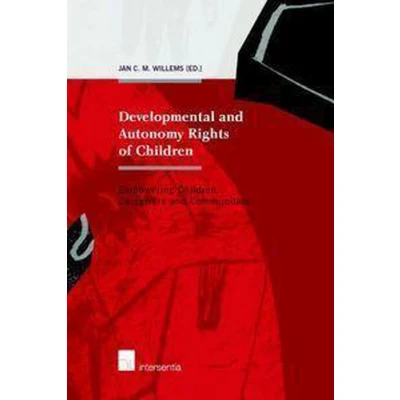
Developmental and Autonomy Rights of Children
Uitgelicht

|
35,50 |
Naar shop
|
| VERGELIJK ALLE AANBIEDERS (1) | ||
 Beschrijving
Bol Partner
On November 20, 1989 , the United Nations unanimously adopted the Convention on the Rights of the Child. This date signals the recognition by the international community that children have developmental and autonomy rights as essential benchmarks for children themselves and for those responsible for their healthy physical, emotional, social, moral and intellectual development. However, as long as Early Child Development, rehabilitation of traumatised children and caregivers, empowerment of children, caregivers and communities, and international solidarity and co-operation with respect to the international rights of the child are only good intentions, the developmental and autonomy rights of all children, and especially the rights of young children and children living in extremely difficult conditions, are nominal rights only. The emancipation of the young child and the rehabilitation and emancipation of the deprived, exploited and oppressed child remain in a legal shadow land. This book intends to explore this shadow land, and to shed some light on different quarters and corners thereof. This is done from the perspective of the Children’s Law of Nations, which carries the principle of the right of the child to become an optimal person as its main paradigm. The authors participated in the Project Group on the Rights of the Child of the Maastricht Centre for Human Rights.


Vergelijk aanbieders (1)

 Beschrijving
(1)
Beschrijving
(1)
On November 20, 1989 , the United Nations unanimously adopted the Convention on the Rights of the Child. This date signals the recognition by the international community that children have developmental and autonomy rights as essential benchmarks for children themselves and for those responsible for their healthy physical, emotional, social, moral and intellectual development. However, as long as Early Child Development, rehabilitation of traumatised children and caregivers, empowerment of children, caregivers and communities, and international solidarity and co-operation with respect to the international rights of the child are only good intentions, the developmental and autonomy rights of all children, and especially the rights of young children and children living in extremely difficult conditions, are nominal rights only. The emancipation of the young child and the rehabilitation and emancipation of the deprived, exploited and oppressed child remain in a legal shadow land. This book intends to explore this shadow land, and to shed some light on different quarters and corners thereof. This is done from the perspective of the Children’s Law of Nations, which carries the principle of the right of the child to become an optimal person as its main paradigm. The authors participated in the Project Group on the Rights of the Child of the Maastricht Centre for Human Rights.
 Productspecificaties
| EAN |
|
|---|---|
| Maat |
|
 Prijshistorie
Prijzen voor het laatst bijgewerkt op:
 Gerelateerde resultaten


