


€ 33,99 Gratis verzending

Uitgelicht
|
|
33,99 |
Naar shop
|

|
37,58 |
Naar shop
|

|
37,58 |
Naar shop
|
| VERGELIJK ALLE AANBIEDERS (3) | ||
 Beschrijving
Vergelijk aanbieders (3)
€ 33,99 Gratis verzending
€ 37,58 Gratis verzending
€ 37,58 Gratis verzending
Winkels met andere maten
Beschrijving
(1)
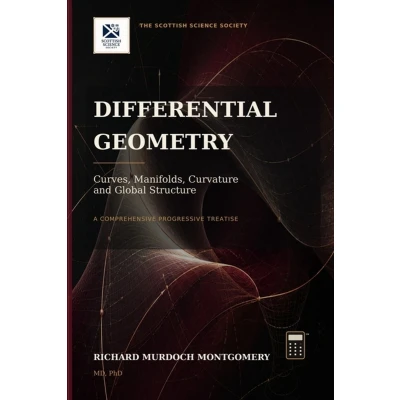
Differential geometry studies what may be differentiated in form, what survives a change of description, and what local measurement can compel us to conclude about an entire space. This treatise has been written to make those three questions continuous. It begins where geometry can still be drawn without apology, advances through the manifold language that abstraction requires, and ends where curvature, topology, symmetry, physics, and computation have become mutually answerable. The volume contains twenty-three numbered chapters arranged in six parts. Parts I and II derive the analytical, multilinear, curve, and surface foundations. Parts III and IV pass from smooth manifolds and tensor fields to metrics, connections, geodesics, curvature, and submanifold geometry. Part V develops the global consequences of variation, comparison, completeness, compactness, and characteristic formulae. Part VI treats Lie groups, homogeneous spaces, fibre bundles, gauge geometry, symplectic and complex structures, and the differential geometry of relativity. Six appendices consolidate the machinery on which the principal argument depends: linear algebra and spectral theory; point-set topology; ordinary differential equations; algebraic topology; coordinate and curvature formulae; and computational differential geometry. The appendices are not a ceremonial warehouse. Each is meant to be read when a theorem in the main text discloses a debt that the reader wishes to collect. Every numbered equation is intended to be earned. Variables are introduced, hypotheses are stated, and coordinate formulae are repeatedly translated into invariant meaning. Colour figures are used as instruments of thought rather than decoration. Guided examples are followed by exercises with complete resolutions, because a geometry known only from elegant statements is apt to become a gallery in which nobody is permitted to touch the furniture. The book is progressive but not elementary in the pejorative sense. A reader may enter from mathematics, physics, engineering, computing, medicine, or another quantitative science; the required allegiance is not to a particular undergraduate syllabus but to proof, calculation, and abstraction in alternation. The detailed contents and subject index are designed to support both sustained reading and later consultation. No work of this length escapes the possibility of error. I would be very glad if corrections, suspected errors, infelicities of notation, or incomplete references were transmitted to [email protected]. Please include the page and, where relevant, the equation, figure, chapter, or appendix number. Any errors that remain are exclusively my own fault; neither the reader, the subject, nor the printer should be made to answer for them. Richard Murdoch Montgomery, MD, PhD, 2026
 Prijshistorie
 * Prijshistorie bevat geen data van Amazon, Amazon Marketplace.
Prijzen voor het laatst bijgewerkt op:
 Gerelateerde resultaten
 Productspecificaties


