


€ 123,20 Gratis verzending

Gesponsorde links
|
|
123,20 |
Naar shop
|

|
129,74 |
Naar shop
|

|
129,74 |
Naar shop
|
| VERGELIJK ALLE AANBIEDERS (3) | ||
 Beschrijving
Vergelijk aanbieders (3)
Gesponsorde links · Sommige shops betalen ons een vergoeding
€ 123,20 Gratis verzending
€ 129,74 Gratis verzending
€ 129,74 Gratis verzending
Winkels met andere maten
Beschrijving
(1)
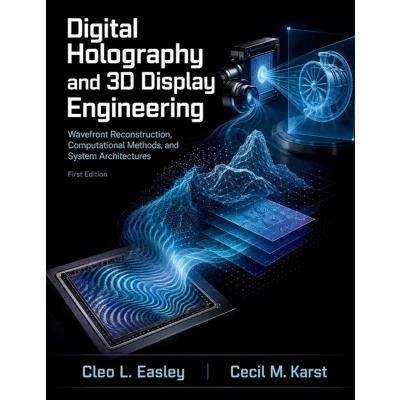
A holographic system can fail even when every individual formula looks correct. A recording may violate sensor sampling limits. A reconstruction may use the wrong propagation regime. A fast hologram algorithm may produce a field the display hardware cannot reproduce. A wider viewing target may be defeated by coherence, speckle, eyebox, field of view, or optical information limits.This book connects those problems into one engineering pathway.Starting with wave behavior, diffraction, coherence, and interference, it builds the foundation for recording and reconstructing complex optical fields. It then moves through digital sensors, sampling and noise, numerical propagation, refocusing, phase recovery, and quantitative phase imaging before reversing the problem: computing the hologram required to reproduce a desired three-dimensional scene.Readers will learn how to: - connect optical theory to digital recording and measurable system limits;- compare reconstruction methods by distance, sampling, accuracy, and computational cost;- understand phase-shifting, twin-image suppression, phase unwrapping, and quantitative measurement;- evaluate direct, layered, intermediate-plane, iterative, parallel, and learned hologram-generation approaches;- specify spatial light modulation while accounting for pitch, phase depth, fill factor, refresh behavior, and viewing range;- reason through color, parallax, eyebox, field of view, speckle control, and optical throughput;- compare three-dimensional display families and evaluate compression, pipeline design, and emerging architectures.Worked examples and practice problems keep the emphasis on engineering judgment. Calculations are used to test whether an assumption is physically valid, whether an algorithm is computationally feasible, and whether a subsystem remains compatible with the hardware around it. Across the book, the same design discipline recurs: fundamental limits remain binding, independent costs can compound, and every technique trades one constraint for another.The book is intended for upper-level engineering students, graduate students, researchers entering optical or computational imaging, and practicing engineers who are comfortable with vector calculus and frequency-domain analysis but do not require prior specialist training in holography.If you need a structured resource that carries the subject from optical foundations through computational hologram generation to complete display-system decisions, begin here and study the field as the connected engineering problem it really is.
 Prijshistorie
* Prijshistorie bevat geen data van Amazon, Amazon Marketplace.
Prijzen voor het laatst bijgewerkt op:
 Gerelateerde resultaten
 Productspecificaties


