
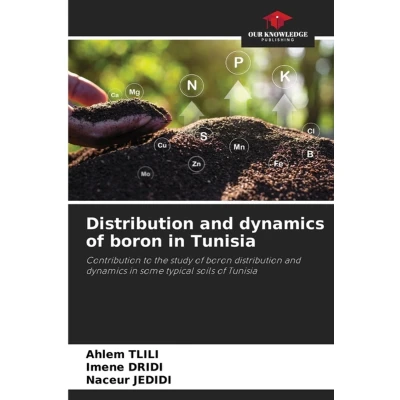
distribution and dynamics of boron in Tunisia: Contribution to the study some typical soils Tunisia
Uitgelicht

|
79,90 |
Naar shop
|
| VERGELIJK ALLE AANBIEDERS (1) | ||
 Beschrijving
Bol
Boron is a soil microelement with a narrow margin between deficiency and toxicity. The results show a decrease in available boron with depth for calcareous soils (Luvisol-1, Vertisol, Fluvisol and Cambisol), while they increase in non-calcareous soils (Luvisol-2 and Luvisol-3). Calcareous soils contain more total boron than non-calcareous ones. Chemical fractionation shows that readily soluble boron represents less than 1.7% of the total, while the residual fraction exceeds 97.5%. Granulometric fractionation reveals that the majority of available boron is associated with the silty fraction (51%), followed by the sandy (34%) and clayey (15%) fractions. In terms of humic substances, humic acids account for 70.69% of total boron, compared with 27.88% for fulvic acids and 1.43% for humin. Adsorption and desorption follow the Freundlich isotherm, with high boron retention during the desorption process. In hydroponics, the optimum boron dose for lettuce (Lactuca sativa L.) is 0.5-5 mg/kg to avoid toxicity. However, for soil-grown lettuce, this concentration may exceed 5 mg/kg.


Vergelijk aanbieders (1)

 Beschrijving
(1)
Beschrijving
(1)
Boron is a soil microelement with a narrow margin between deficiency and toxicity. The results show a decrease in available boron with depth for calcareous soils (Luvisol-1, Vertisol, Fluvisol and Cambisol), while they increase in non-calcareous soils (Luvisol-2 and Luvisol-3). Calcareous soils contain more total boron than non-calcareous ones. Chemical fractionation shows that readily soluble boron represents less than 1.7% of the total, while the residual fraction exceeds 97.5%. Granulometric fractionation reveals that the majority of available boron is associated with the silty fraction (51%), followed by the sandy (34%) and clayey (15%) fractions. In terms of humic substances, humic acids account for 70.69% of total boron, compared with 27.88% for fulvic acids and 1.43% for humin. Adsorption and desorption follow the Freundlich isotherm, with high boron retention during the desorption process. In hydroponics, the optimum boron dose for lettuce (Lactuca sativa L.) is 0.5-5 mg/kg to avoid toxicity. However, for soil-grown lettuce, this concentration may exceed 5 mg/kg.
 Productspecificaties
| EAN |
|
|---|---|
| Maat |
|
 Prijshistorie
Prijzen voor het laatst bijgewerkt op:
 Gerelateerde resultaten


