
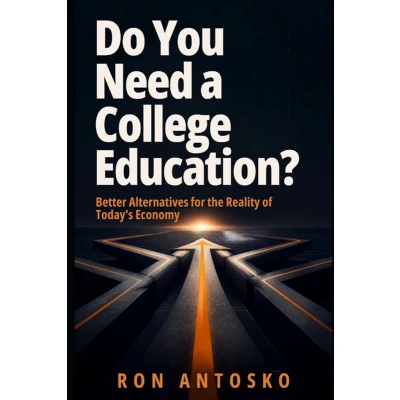
Do You Need a College Education? : Better Alternatives for the Reality of Today's Economy
Uitgelicht

|
11,95 |
Naar shop
|

|
11,95 |
Naar shop
|

|
12,50 |
Naar shop
|
| VERGELIJK ALLE AANBIEDERS (3) | ||
 Beschrijving
Bol
Do You Need a College Education?: Better Alternatives for Today's Economy challenges one of the most deeply rooted assumptions in modern life-that a four-year college degree is the only reliable path to stability, opportunity, and long-term success. In an era defined by automation, rising tuition costs, shifting job markets, and the explosive growth of alternative learning models, this book argues that the traditional college track is no longer the universal best fit. Instead, readers are invited to explore a wider landscape of options that are often faster, cheaper, more flexible, and better aligned with today's economic realities.The book begins by examining how the value of a college degree has changed. While higher education once guaranteed upward mobility, many graduates now face heavy debt, uncertain job prospects, and skills mismatched to employer needs. The author breaks down the economic forces reshaping the labor market-automation, AI-driven workflows, remote work, global competition, and the rise of skill-based hiring. Readers learn why employers increasingly prioritize competence over credentials, and how nontraditional pathways can meet this demand more effectively.A major theme is practical alternatives. The book explores modern options such as skills-based certifications, apprenticeships, trade careers, bootcamps, micro-degrees, online learning platforms, and entrepreneurial paths. Each alternative is evaluated for cost, time investment, earning potential, and long-term viability. Real-world examples show how individuals have built strong careers without traditional college-often with less debt and greater flexibility.Another key section explores personal fit. The author emphasizes that the right path depends on the individual's goals, strengths, financial situation, and learning style. Readers learn how to assess whether college is the best choice for their ambitions-or whether a different route offers a better return on investment. The book provides frameworks for evaluating programs, comparing costs, and understanding the difference between "education" and "credentialing."The book also addresses hybrid futures, where college remains valuable for certain fields-medicine, engineering, law-while alternative pathways dominate others. Readers gain a balanced perspective that avoids both blind loyalty to college and blanket rejection of it. Instead, the book encourages strategic decision-making based on evidence, economics, and personal vision.Finally, Do You Need a College Education? offers a roadmap for building a successful career without a degree. Readers learn how to create a skill-development plan, build a portfolio, leverage AI tools for learning, network effectively, and position themselves competitively in a skills-first job market. The book closes with a hopeful message: in today's economy, opportunity is no longer gated by a diploma-it is gated by initiative, adaptability, and the willingness to learn.


 Beschrijving
(1)
Beschrijving
(1)
Do You Need a College Education?: Better Alternatives for Today's Economy challenges one of the most deeply rooted assumptions in modern life-that a four-year college degree is the only reliable path to stability, opportunity, and long-term success. In an era defined by automation, rising tuition costs, shifting job markets, and the explosive growth of alternative learning models, this book argues that the traditional college track is no longer the universal best fit. Instead, readers are invited to explore a wider landscape of options that are often faster, cheaper, more flexible, and better aligned with today's economic realities.The book begins by examining how the value of a college degree has changed. While higher education once guaranteed upward mobility, many graduates now face heavy debt, uncertain job prospects, and skills mismatched to employer needs. The author breaks down the economic forces reshaping the labor market-automation, AI-driven workflows, remote work, global competition, and the rise of skill-based hiring. Readers learn why employers increasingly prioritize competence over credentials, and how nontraditional pathways can meet this demand more effectively.A major theme is practical alternatives. The book explores modern options such as skills-based certifications, apprenticeships, trade careers, bootcamps, micro-degrees, online learning platforms, and entrepreneurial paths. Each alternative is evaluated for cost, time investment, earning potential, and long-term viability. Real-world examples show how individuals have built strong careers without traditional college-often with less debt and greater flexibility.Another key section explores personal fit. The author emphasizes that the right path depends on the individual's goals, strengths, financial situation, and learning style. Readers learn how to assess whether college is the best choice for their ambitions-or whether a different route offers a better return on investment. The book provides frameworks for evaluating programs, comparing costs, and understanding the difference between "education" and "credentialing."The book also addresses hybrid futures, where college remains valuable for certain fields-medicine, engineering, law-while alternative pathways dominate others. Readers gain a balanced perspective that avoids both blind loyalty to college and blanket rejection of it. Instead, the book encourages strategic decision-making based on evidence, economics, and personal vision.Finally, Do You Need a College Education? offers a roadmap for building a successful career without a degree. Readers learn how to create a skill-development plan, build a portfolio, leverage AI tools for learning, network effectively, and position themselves competitively in a skills-first job market. The book closes with a hopeful message: in today's economy, opportunity is no longer gated by a diploma-it is gated by initiative, adaptability, and the willingness to learn.
 Productspecificaties
 Prijshistorie
* Prijshistorie bevat geen data van Amazon, Amazon Marketplace.
Prijzen voor het laatst bijgewerkt op:
 Gerelateerde resultaten


