

€ 24,39 Gratis verzending

Gesponsorde links
|
|
24,39 |
Naar shop
|

|
24,39 |
Naar shop
|

|
26,99 |
Naar shop
|
| VERGELIJK ALLE AANBIEDERS (3) | ||
 Beschrijving
Vergelijk aanbieders (3)
Gesponsorde links · Sommige shops betalen ons een vergoeding
€ 24,39 Gratis verzending
€ 24,39 Gratis verzending
€ 26,99 Gratis verzending
Winkels met andere maten
Beschrijving
(1)
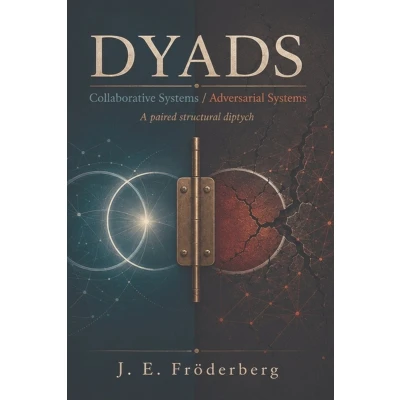
Can the same romantic dyad be collaborative at one level and adversarial at another?DYADS presents a paired structural analysis of the romantic dyad under two distinct operating regimes.The first half, Collaborative Systems, examines how dyads remain legible and coordinated through role distribution, recognition, regulation, load-sharing, adaptation, and the continuing possibility of mutual recalibration. Its concern is not whether a relationship is perfectly symmetrical, but whether its internal organisation remains sufficiently intelligible and responsive for collaboration to continue.The second half, Adversarial Systems, examines what happens when that operating logic changes. Illegibility, audit pressure, passive availability, asymmetric exposure, interpretive displacement, and boundary shift can alter the structure of the relation itself. Behaviour that appears to belong to the same relationship may therefore require a different analytical frame once the governing regime has changed.Between the two halves lies The Hinge: a level-specific account of how the same dyad may present collaborative and adversarial properties depending on what is being observed, at what level, and under which structural conditions.Read together, the two books form a structural diptych. Collaboration and adversariality are not treated as simple psychological opposites or moral labels. They are analysed as different operating regimes that may coexist, alternate, emerge gradually, or become visible only after a change in the relational system.The book develops a vocabulary for examining: - coordination, roles, asymmetry, and load - recognition, legibility, and regulation - adaptation and recalibration - passive availability and asymmetric exposure - audit, interpretive shift, and boundary formation - regime change and the limits of collaborative analysisDYADS is written for students, researchers, and reflective practitioners interested in sociology, relational systems, family studies, and structural analysis of intimate relationships.It is not a therapy manual, self-help book, diagnostic instrument, or guide to determining blame. Its purpose is analytical: to distinguish the structural conditions under which a dyad remains collaboratively legible from those under which a different analytical regime becomes necessary.
 Prijshistorie
* Prijshistorie bevat geen data van Amazon, Amazon Marketplace.
Prijzen voor het laatst bijgewerkt op:
 Gerelateerde resultaten
 Productspecificaties


