
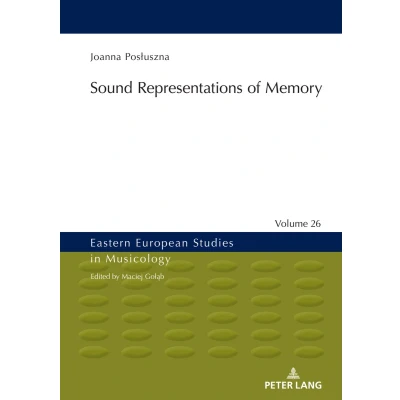
Eastern European Studies in Musicology Sound Representations of Memory
Uitgelicht

|
40,99 |
Naar shop
|
| VERGELIJK ALLE AANBIEDERS (1) | ||
 Beschrijving
Bol
The author outlines how memory is treated by contemporary artists, philosophers, musicians, sociologists, musicologists, as well as victims of the Holocaust… She paints a rich landscape of how her subject features in the work of composers and their collaborators, many of whom were motivated by memories of the Occupation. The author outlines how memory is treated by contemporary artists, philosophers, musicians, sociologists, musicologists, as well as victims of the Holocaust… She paints a rich landscape of how her subject features in the work of composers and their collaborators, many of whom were motivated by memories of the Occupation. With such a subject, the discussion inevitably comes round to the uneasy relationship between aesthetics and ethics. The author quotes Adorno: “Is poetry possible after Auschwitz?”. The work is an answer to that question, and an affirmative one. It must be possible: to restore hope, and to invoke and sustain Memory, at least symbolically – by artistic means. Art, even when it disturbs, brings catharsis and preserves memory. The author impresses with her erudition, wealth of materials cited, musical competence and critical insights. Krzysztof Szwajgier, The Krzysztof Penderecki Academy of Music, Cracow, Poland.


Vergelijk aanbieders (1)

 Beschrijving
(1)
Beschrijving
(1)
The author outlines how memory is treated by contemporary artists, philosophers, musicians, sociologists, musicologists, as well as victims of the Holocaust… She paints a rich landscape of how her subject features in the work of composers and their collaborators, many of whom were motivated by memories of the Occupation. The author outlines how memory is treated by contemporary artists, philosophers, musicians, sociologists, musicologists, as well as victims of the Holocaust… She paints a rich landscape of how her subject features in the work of composers and their collaborators, many of whom were motivated by memories of the Occupation. With such a subject, the discussion inevitably comes round to the uneasy relationship between aesthetics and ethics. The author quotes Adorno: “Is poetry possible after Auschwitz?”. The work is an answer to that question, and an affirmative one. It must be possible: to restore hope, and to invoke and sustain Memory, at least symbolically – by artistic means. Art, even when it disturbs, brings catharsis and preserves memory. The author impresses with her erudition, wealth of materials cited, musical competence and critical insights. Krzysztof Szwajgier, The Krzysztof Penderecki Academy of Music, Cracow, Poland.
 Productspecificaties
| EAN |
|
|---|---|
| Maat |
|
 Prijshistorie
Prijzen voor het laatst bijgewerkt op:
 Gerelateerde resultaten


