








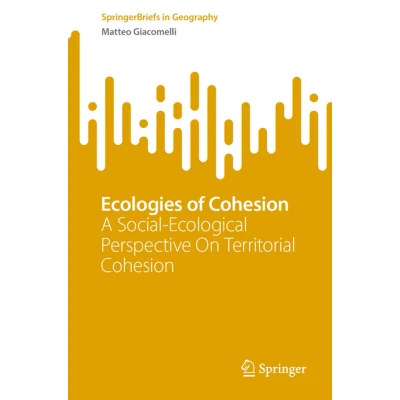
Ecologies of Cohesion: A Social Ecological Perspective On Territorial Cohesion
Uitgelicht

|
46,99 |
Naar shop
|

|
53,49 |
Naar shop
|

|
53,49 |
Naar shop
|
 Beschrijving
Bol
This book presents a groundbreaking ecological perspective on territorial cohesion, a cornerstone of the European Union's vision outlined in the Lisbon Treaty of 2009, defined as the pursuit of balanced and harmonious development across regions. This book presents a groundbreaking ecological perspective on territorial cohesion, a cornerstone of the European Union's vision outlined in the Lisbon Treaty of 2009, defined as the pursuit of balanced and harmonious development across regions. In a world where urban centers are often synonymous with economic prowess, this work shifts the focus to the overlooked inland and rural areas experiencing economic decline and depopulation. In the context of public policies, the title Ecology of Cohesion reflects the book's strong aim to apply a multidisciplinary approach, drawing insights from the environmental and social sciences. The network of relations portrayed by the title is in the book investigated through the concept of Ecosystem Services (ES), defined as the benefits humans derive from ecosystems. This concept is used to analyse landscapes as a portion of territory composed of anthropic and natural features coupled to the point that they should be conceived as one social-ecological system. The result is an innovative framework that interprets regional interdependencies and addresses inequalities within regions. This book presents a groundbreaking ecological perspective on territorial cohesion, a cornerstone of the European Union's vision outlined in the Lisbon Treaty of 2009, defined as the pursuit of balanced and harmonious development across regions. In a world where urban centers are often synonymous with economic prowess, this work shifts the focus to the overlooked inland and rural areas experiencing economic decline and depopulation. In the context of public policies, the title Ecology of Cohesion reflects the book's strong aim to apply a multidisciplinary approach, drawing insights from the environmental and social sciences. The network of relations portrayed by the title is in the book investigated through the concept of Ecosystem Services (ES), defined as the benefits humans derive from ecosystems. This concept is used to analyse landscapes as a portion of territory composed of anthropic and natural features coupled to the point that they should be conceived as one social-ecological system. The result is an innovative framework that interprets regional interdependencies and addresses inequalities within regions. The aim of the book is to integrate an environmental perspective on territorial cohesion by incorporating diverse notions into the construction of a new theoretical framework. While describing the different components of the framework, it is practically applied through a real case study: Le Marche, Italy. After providing a clear definition of theoretical concepts, the book explores the links between theory and practice, illustrating how these notions are applied to the case study. The case study is accurately described, highlighting the specific challenges faced, strategies adopted, and results achieved. Practical guidelines assist readers in reflecting on the applicability of theoretical concepts to other specific contexts by extracting the “polycentric territory” condition. This key concept is introduced through a description of how the region's geographic, cultural, and economic characteristics influence (and are influenced by) the urban gradient (level of peripherality). This is exemplified in Le Marche with particular emphasis on how the specific conclusions can inform landscape planning in other regions with similar characteristics. As global pressures mount on inland ecosystems, this book goes beyond academic discourse. It provides a set of recommendations for sustainable landscape planning, advocating for the preservation of the identity of inland systems through the enhancement of local ecosystem management. The book not only produces a new environmental-based argument for territorial cohesion but also offers actionable insights for policymakers and practitioners.


 Beschrijving
(1)
Beschrijving
(1)
This book presents a groundbreaking ecological perspective on territorial cohesion, a cornerstone of the European Union's vision outlined in the Lisbon Treaty of 2009, defined as the pursuit of balanced and harmonious development across regions. This book presents a groundbreaking ecological perspective on territorial cohesion, a cornerstone of the European Union's vision outlined in the Lisbon Treaty of 2009, defined as the pursuit of balanced and harmonious development across regions. In a world where urban centers are often synonymous with economic prowess, this work shifts the focus to the overlooked inland and rural areas experiencing economic decline and depopulation. In the context of public policies, the title Ecology of Cohesion reflects the book's strong aim to apply a multidisciplinary approach, drawing insights from the environmental and social sciences. The network of relations portrayed by the title is in the book investigated through the concept of Ecosystem Services (ES), defined as the benefits humans derive from ecosystems. This concept is used to analyse landscapes as a portion of territory composed of anthropic and natural features coupled to the point that they should be conceived as one social-ecological system. The result is an innovative framework that interprets regional interdependencies and addresses inequalities within regions. This book presents a groundbreaking ecological perspective on territorial cohesion, a cornerstone of the European Union's vision outlined in the Lisbon Treaty of 2009, defined as the pursuit of balanced and harmonious development across regions. In a world where urban centers are often synonymous with economic prowess, this work shifts the focus to the overlooked inland and rural areas experiencing economic decline and depopulation. In the context of public policies, the title Ecology of Cohesion reflects the book's strong aim to apply a multidisciplinary approach, drawing insights from the environmental and social sciences. The network of relations portrayed by the title is in the book investigated through the concept of Ecosystem Services (ES), defined as the benefits humans derive from ecosystems. This concept is used to analyse landscapes as a portion of territory composed of anthropic and natural features coupled to the point that they should be conceived as one social-ecological system. The result is an innovative framework that interprets regional interdependencies and addresses inequalities within regions. The aim of the book is to integrate an environmental perspective on territorial cohesion by incorporating diverse notions into the construction of a new theoretical framework. While describing the different components of the framework, it is practically applied through a real case study: Le Marche, Italy. After providing a clear definition of theoretical concepts, the book explores the links between theory and practice, illustrating how these notions are applied to the case study. The case study is accurately described, highlighting the specific challenges faced, strategies adopted, and results achieved. Practical guidelines assist readers in reflecting on the applicability of theoretical concepts to other specific contexts by extracting the “polycentric territory” condition. This key concept is introduced through a description of how the region's geographic, cultural, and economic characteristics influence (and are influenced by) the urban gradient (level of peripherality). This is exemplified in Le Marche with particular emphasis on how the specific conclusions can inform landscape planning in other regions with similar characteristics. As global pressures mount on inland ecosystems, this book goes beyond academic discourse. It provides a set of recommendations for sustainable landscape planning, advocating for the preservation of the identity of inland systems through the enhancement of local ecosystem management. The book not only produces a new environmental-based argument for territorial cohesion but also offers actionable insights for policymakers and practitioners.
 Productspecificaties
 Prijshistorie
* Prijshistorie bevat geen data van Amazon, Amazon Marketplace.
Prijzen voor het laatst bijgewerkt op:
 Gerelateerde resultaten


