


€ 51,99 Gratis verzending

Uitgelicht
|
|
51,99 |
Naar shop
|
| VERGELIJK ALLE AANBIEDERS (1) | ||
 Beschrijving
Vergelijk aanbieders (1)
€ 51,99 Gratis verzending
Winkels met andere maten
Beschrijving
(1)
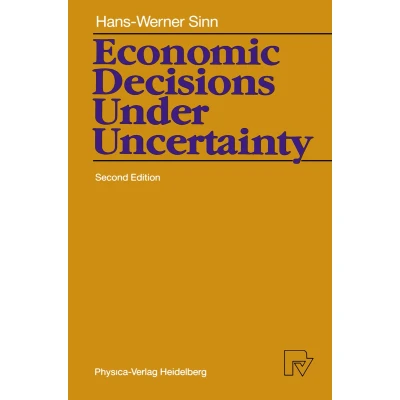
A stronger reason for developing a theory of uncertainty, therefore, seems to be the fact that there are kinds of economic activities to which the non-stochastic preference theory has no access or has access only through highly artificial constructions. The Fundamental Issues Involved Why do we need a theory of uncertainty? It is a fact that almost all man's economic decisions are made under conditions of uncertainty, but this fact alone does not provide a strong enough argument for making the effort necessary to generalize ordinary preference theory designed for a world of perfect certainty. In accordance with Occam's Razor, the mathematician may well welcome a generalization of assumptions even if it does not promise more than a restatement of known results. The economist, however, will only be well disposed towards making the effort if he can expect to achieve new insights and interesting results, for he is interested in the techniques necessary for the generalization only as means to an end, not as ends in themselves. A stronger reason for developing a theory of uncertainty, therefore, seems to be the fact that there are kinds of economic activities to which the non-stochastic preference theory has no access or has access only through highly artificial constructions. Such activities include portfolio decisions of wealth holders, speculation, and insurance. These will be considered in detail in the last chapter of the book. The main purpose of this book, however, is not to apply a theory of uncertainty to concrete economic problems, the purpose rather is to formulate such a theory.
 Productspecificaties
| EAN |
|
|---|---|
| Maat |
|
 Prijshistorie
 Prijzen voor het laatst bijgewerkt op:
 Gerelateerde resultaten


