
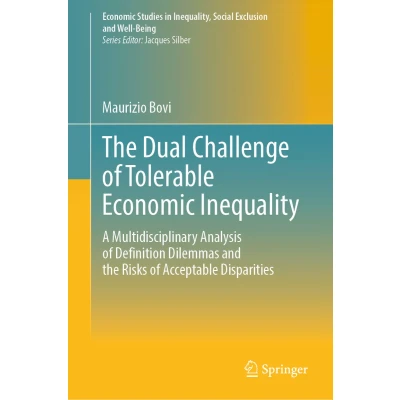
Economic Studies in Inequality, Social Exclusion and Well Being The Dual Challenge of Tolerable Inequality
Uitgelicht

|
109,00 |
Naar shop
|
| VERGELIJK ALLE AANBIEDERS (1) | ||
 Beschrijving
Bol
Second, while tolerable inequality has the potential to evolve into systemic patterns of polarization, segregation, and discrimination, it can ultimately escalate into unjustifiable inequality. This book tackles two central challenges in the discourse on economic inequality. First, there is no consensus on what constitutes a morally acceptable inequality, as even philosophers struggle to conceptualize benchmarks for distinguishing between acceptable and unacceptable disparities. Second, while tolerable inequality has the potential to evolve into systemic patterns of polarization, segregation, and discrimination, it can ultimately escalate into unjustifiable inequality. This self-reinforcing cycle complicates efforts to achieve equitable distributions. The book explores these challenges in two sections through a multidisciplinary lens. Part one discusses distributive justice and philosophical debates surrounding inequality’s acceptable boundaries. Part two employs the concept of social aggregations—such as families, cities, firms, and nations—to examine how even initially tolerable inequality can spread and intensify through interconnected social systems. By emphasizing the relational nature of inequality, the book underscores its systemic complexity and the need for holistic understanding. This book tackles two central challenges in the discourse on economic inequality. First, there is no consensus on what constitutes a morally acceptable inequality, as even philosophers struggle to conceptualize benchmarks for distinguishing between acceptable and unacceptable disparities. Second, while tolerable inequality has the potential to evolve into systemic patterns of polarization, segregation, and discrimination, it can ultimately escalate into unjustifiable inequality. This self-reinforcing cycle complicates efforts to achieve equitable distributions. The book explores these challenges in two sections through a multidisciplinary lens. Part one discusses distributive justice and philosophical debates surrounding inequality’s acceptable boundaries. Part two employs the concept of social aggregations—such as families, cities, firms, and nations—to examine how even initially tolerable inequality can spread and intensify through interconnected social systems. By emphasizing the relational nature of inequality, the book underscores its systemic complexity and the need for holistic understanding.


Vergelijk aanbieders (1)

 Beschrijving
(1)
Beschrijving
(1)
Second, while tolerable inequality has the potential to evolve into systemic patterns of polarization, segregation, and discrimination, it can ultimately escalate into unjustifiable inequality. This book tackles two central challenges in the discourse on economic inequality. First, there is no consensus on what constitutes a morally acceptable inequality, as even philosophers struggle to conceptualize benchmarks for distinguishing between acceptable and unacceptable disparities. Second, while tolerable inequality has the potential to evolve into systemic patterns of polarization, segregation, and discrimination, it can ultimately escalate into unjustifiable inequality. This self-reinforcing cycle complicates efforts to achieve equitable distributions. The book explores these challenges in two sections through a multidisciplinary lens. Part one discusses distributive justice and philosophical debates surrounding inequality’s acceptable boundaries. Part two employs the concept of social aggregations—such as families, cities, firms, and nations—to examine how even initially tolerable inequality can spread and intensify through interconnected social systems. By emphasizing the relational nature of inequality, the book underscores its systemic complexity and the need for holistic understanding. This book tackles two central challenges in the discourse on economic inequality. First, there is no consensus on what constitutes a morally acceptable inequality, as even philosophers struggle to conceptualize benchmarks for distinguishing between acceptable and unacceptable disparities. Second, while tolerable inequality has the potential to evolve into systemic patterns of polarization, segregation, and discrimination, it can ultimately escalate into unjustifiable inequality. This self-reinforcing cycle complicates efforts to achieve equitable distributions. The book explores these challenges in two sections through a multidisciplinary lens. Part one discusses distributive justice and philosophical debates surrounding inequality’s acceptable boundaries. Part two employs the concept of social aggregations—such as families, cities, firms, and nations—to examine how even initially tolerable inequality can spread and intensify through interconnected social systems. By emphasizing the relational nature of inequality, the book underscores its systemic complexity and the need for holistic understanding.
 Productspecificaties
| EAN |
|
|---|---|
| Maat |
|
 Prijshistorie
Prijzen voor het laatst bijgewerkt op:
 Gerelateerde resultaten


