
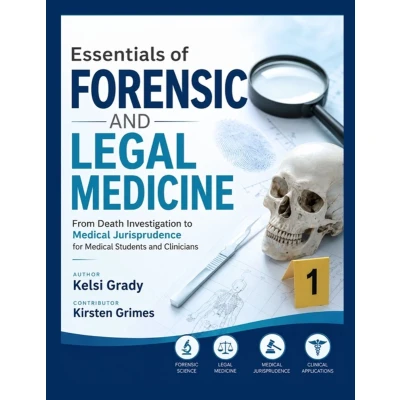
Essentials of Forensic and Legal Medicine: From Death Investigation to Medical Jurisprudence for Students Clinicians
Uitgelicht

|
151,00
149,00 |
Naar shop
|

|
165,52 |
Naar shop
|

|
165,52 |
Naar shop
|
| VERGELIJK ALLE AANBIEDERS (3) | ||
 Beschrijving
Bol
Understand the evidence. Interpret the findings. Communicate conclusions that can withstand clinical and courtroom scrutiny. Essentials of Forensic and Legal Medicine delivers a structured, clinically oriented reference for medical students, residents, physicians, and practitioners who need a dependable foundation in the science, ethics, and law surrounding injury, death, and professional responsibility. Across twenty focused chapters, the text connects the biological investigation of death with the examination of living patients, wound interpretation, autopsy practice, toxicology, death certification, consent, confidentiality, professional regulation, expert testimony, and safeguarding. Complex principles are explained through practical clinical framing, case-based applications, clearly defined learning objectives, clinical pearls, and educational diagrams that support retention and real-world use. With this resource, you will: - Trace the historical development, scope, and major systems of medicolegal practice.- Distinguish natural, accidental, suicidal, homicidal, and undetermined manners of death.- Apply systematic approaches to scene assessment, post-mortem change, autopsy, and identification.- Interpret blunt, sharp, firearm, asphyxial, thermal, chemical, and environmental injuries.- Strengthen your understanding of poisoning, alcohol, drug-related fatalities, and specimen handling.- Navigate consent, capacity, confidentiality, mandatory reporting, ethics, and professional regulation.- Prepare clearer documentation, defensible opinions, and impartial evidence for legal proceedings. The progression from foundational principles to advanced applications helps you see how individual findings fit into the wider investigative process. Discussions of chain of custody, evidentiary limitations, quality assurance, trauma-informed care, digital records, imaging, and emerging technology reinforce the standards expected in contemporary practice. Jurisdictional differences are acknowledged throughout, allowing readers to recognise when local legislation, court rules, or professional guidance must be checked before applying a principle. The book is especially useful for readers who want one integrated reference rather than separate introductory texts on pathology, toxicology, clinical examination, medical law, and courtroom practice. Its broad scope also makes it suitable for revision, teaching support, professional orientation, and reference during clinical or academic work. Develop a more organised understanding of how medical evidence is collected, interpreted, documented, and presented - and build the disciplined reasoning required at the intersection of healthcare and justice.


 Beschrijving
(1)
Beschrijving
(1)
Understand the evidence. Interpret the findings. Communicate conclusions that can withstand clinical and courtroom scrutiny. Essentials of Forensic and Legal Medicine delivers a structured, clinically oriented reference for medical students, residents, physicians, and practitioners who need a dependable foundation in the science, ethics, and law surrounding injury, death, and professional responsibility. Across twenty focused chapters, the text connects the biological investigation of death with the examination of living patients, wound interpretation, autopsy practice, toxicology, death certification, consent, confidentiality, professional regulation, expert testimony, and safeguarding. Complex principles are explained through practical clinical framing, case-based applications, clearly defined learning objectives, clinical pearls, and educational diagrams that support retention and real-world use. With this resource, you will: - Trace the historical development, scope, and major systems of medicolegal practice.- Distinguish natural, accidental, suicidal, homicidal, and undetermined manners of death.- Apply systematic approaches to scene assessment, post-mortem change, autopsy, and identification.- Interpret blunt, sharp, firearm, asphyxial, thermal, chemical, and environmental injuries.- Strengthen your understanding of poisoning, alcohol, drug-related fatalities, and specimen handling.- Navigate consent, capacity, confidentiality, mandatory reporting, ethics, and professional regulation.- Prepare clearer documentation, defensible opinions, and impartial evidence for legal proceedings. The progression from foundational principles to advanced applications helps you see how individual findings fit into the wider investigative process. Discussions of chain of custody, evidentiary limitations, quality assurance, trauma-informed care, digital records, imaging, and emerging technology reinforce the standards expected in contemporary practice. Jurisdictional differences are acknowledged throughout, allowing readers to recognise when local legislation, court rules, or professional guidance must be checked before applying a principle. The book is especially useful for readers who want one integrated reference rather than separate introductory texts on pathology, toxicology, clinical examination, medical law, and courtroom practice. Its broad scope also makes it suitable for revision, teaching support, professional orientation, and reference during clinical or academic work. Develop a more organised understanding of how medical evidence is collected, interpreted, documented, and presented - and build the disciplined reasoning required at the intersection of healthcare and justice.
 Productspecificaties
 Prijshistorie
* Prijshistorie bevat geen data van Amazon, Amazon Marketplace.
Prijzen voor het laatst bijgewerkt op:
 Gerelateerde resultaten


