
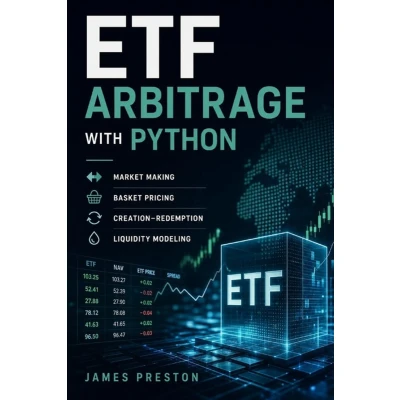
ETF Arbitrage with Python: Market Making, Basket Pricing, Creation-Redemption, and Liquidity Modeling
Uitgelicht

|
29,17 |
Naar shop
|

|
29,17 |
Naar shop
|

|
29,99 |
Naar shop
|
| VERGELIJK ALLE AANBIEDERS (3) | ||
 Beschrijving
Bol
Reactive PublishingExchange-traded funds are built on a market structure that connects fund shares, underlying baskets, authorized participants, liquidity providers, and intraday pricing relationships. ETF Arbitrage with Python provides a practical technical guide to understanding how these relationships work and how they can be modeled with Python.This book explains the core mechanics behind ETF creation and redemption, basket pricing, market making, liquidity behavior, and arbitrage relationships. Rather than focusing on trading claims or simplified profit formulas, it approaches ETF arbitrage as a market-structure problem involving data, pricing logic, execution constraints, and portfolio relationships.Readers will learn how to examine ETF premiums and discounts, compare fund prices against underlying basket values, model liquidity conditions, and build Python workflows for research, analysis, and simulation. The book is designed for quantitative finance readers, analysts, developers, traders, and students who want a clearer technical understanding of ETF pricing systems.Inside, the book covers: Creation-redemption mechanics and ETF primary-market structure Authorized participants and liquidity provider workflows Basket pricing and net asset value relationships Premium and discount analysis ETF liquidity modeling and spread behavior Market making concepts for ETF products Python-based research workflows for ETF data Hedging logic across ETF shares and underlying baskets Practical modeling examples for pricing and arbitrage analysisETF Arbitrage with Python is a structured guide for readers who want to understand how ETF arbitrage works beneath the surface and how Python can be used to study ETF market behavior with greater precision.


 Beschrijving
(1)
Beschrijving
(1)
Reactive PublishingExchange-traded funds are built on a market structure that connects fund shares, underlying baskets, authorized participants, liquidity providers, and intraday pricing relationships. ETF Arbitrage with Python provides a practical technical guide to understanding how these relationships work and how they can be modeled with Python.This book explains the core mechanics behind ETF creation and redemption, basket pricing, market making, liquidity behavior, and arbitrage relationships. Rather than focusing on trading claims or simplified profit formulas, it approaches ETF arbitrage as a market-structure problem involving data, pricing logic, execution constraints, and portfolio relationships.Readers will learn how to examine ETF premiums and discounts, compare fund prices against underlying basket values, model liquidity conditions, and build Python workflows for research, analysis, and simulation. The book is designed for quantitative finance readers, analysts, developers, traders, and students who want a clearer technical understanding of ETF pricing systems.Inside, the book covers: Creation-redemption mechanics and ETF primary-market structure Authorized participants and liquidity provider workflows Basket pricing and net asset value relationships Premium and discount analysis ETF liquidity modeling and spread behavior Market making concepts for ETF products Python-based research workflows for ETF data Hedging logic across ETF shares and underlying baskets Practical modeling examples for pricing and arbitrage analysisETF Arbitrage with Python is a structured guide for readers who want to understand how ETF arbitrage works beneath the surface and how Python can be used to study ETF market behavior with greater precision.
 Productspecificaties
 Prijshistorie
* Prijshistorie bevat geen data van Amazon, Amazon Marketplace.
Prijzen voor het laatst bijgewerkt op:
 Gerelateerde resultaten


