
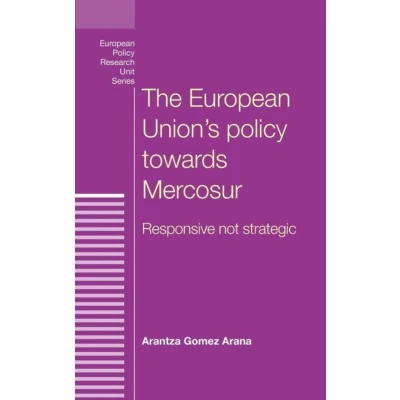
European Union's Policy Towards Mercosur
Uitgelicht

|
80,83 |
Naar shop
|
| VERGELIJK ALLE AANBIEDERS (1) | ||
 Beschrijving
Bol Partner
This book provides a distinctive and empirically rich account of the European Union’s relationship with the Common Market of the South (Mercosur) and the motivations that determine the EU’s policy towards Mercosur. This book provides a distinctive and empirically rich account of the European Union’s relationship with the Common Market of the South (Mercosur). It seeks to examine the motivations that determine the EU’s policy towards Mercosur; the most important relationship the EU has with another regional economic integration organization. In order to investigate these motivations (or lack thereof), this study examines the contribution of the main policy- and decision-makers, the European Commission and the Council of Ministers, as well as the different contributions of the two institutions. It analyses the development of EU policy towards Mercosur in relation to three key stages: non-institutionalized relations (1986–1990), official relations (1991–1995), and the negotiations for an association agreement (1996–2004 and 2010–present).Arana argues that the dominant explanations in the literature fail to adequately explain the EU’s policy, in particular, these accounts tend to infer the EU’s motives from its activity. Drawing on extensive primary documents, the book argues that the major developments in the relationship were initiated by Mercosur and supported mainly by Spain. Rather than the EU pursuing a strategy, as implied by most of the existing literature, the EU was largely responsive, which explains why the relationship is much less developed than the EU’s relations with other parts of the world. The European Union's policy towards Mercosur will benefit academics and postgraduate students of European Union Foreign Affairs, Inter-regionalism and Latin American regionalism. This book provides a distinctive and empirically rich account of the European Union’s relationship with the Common Market of the South (Mercosur). It seeks to examine the motivations that determine the EU’s policy towards Mercosur; the most important relationship the EU has with another regional economic integration organization.In order to investigate these motivations (or lack thereof), this study examines the contribution of the main policy- and decision-makers, the European Commission and the Council of Ministers, as well as the different contributions of the two institutions. It analyses the development of EU policy towards Mercosur in relation to three key stages.Arana argues that the dominant explanations in the literature fail to adequately explain the EU’s policy, in particular, these accounts tend to infer the EU’s motives from its activity. Rather than the EU pursuing a strategy, as implied by most of the existing literature, the EU was largely responsive, which explains why the relationship is much less developed than the EU’s relations with other parts of the world.An electronic edition of this book is freely available under a Creative Commons (CC BY-NC-ND) licence.


Vergelijk aanbieders (1)

 Beschrijving
(1)
Beschrijving
(1)
This book provides a distinctive and empirically rich account of the European Union’s relationship with the Common Market of the South (Mercosur) and the motivations that determine the EU’s policy towards Mercosur. This book provides a distinctive and empirically rich account of the European Union’s relationship with the Common Market of the South (Mercosur). It seeks to examine the motivations that determine the EU’s policy towards Mercosur; the most important relationship the EU has with another regional economic integration organization. In order to investigate these motivations (or lack thereof), this study examines the contribution of the main policy- and decision-makers, the European Commission and the Council of Ministers, as well as the different contributions of the two institutions. It analyses the development of EU policy towards Mercosur in relation to three key stages: non-institutionalized relations (1986–1990), official relations (1991–1995), and the negotiations for an association agreement (1996–2004 and 2010–present).Arana argues that the dominant explanations in the literature fail to adequately explain the EU’s policy, in particular, these accounts tend to infer the EU’s motives from its activity. Drawing on extensive primary documents, the book argues that the major developments in the relationship were initiated by Mercosur and supported mainly by Spain. Rather than the EU pursuing a strategy, as implied by most of the existing literature, the EU was largely responsive, which explains why the relationship is much less developed than the EU’s relations with other parts of the world. The European Union's policy towards Mercosur will benefit academics and postgraduate students of European Union Foreign Affairs, Inter-regionalism and Latin American regionalism. This book provides a distinctive and empirically rich account of the European Union’s relationship with the Common Market of the South (Mercosur). It seeks to examine the motivations that determine the EU’s policy towards Mercosur; the most important relationship the EU has with another regional economic integration organization.In order to investigate these motivations (or lack thereof), this study examines the contribution of the main policy- and decision-makers, the European Commission and the Council of Ministers, as well as the different contributions of the two institutions. It analyses the development of EU policy towards Mercosur in relation to three key stages.Arana argues that the dominant explanations in the literature fail to adequately explain the EU’s policy, in particular, these accounts tend to infer the EU’s motives from its activity. Rather than the EU pursuing a strategy, as implied by most of the existing literature, the EU was largely responsive, which explains why the relationship is much less developed than the EU’s relations with other parts of the world.An electronic edition of this book is freely available under a Creative Commons (CC BY-NC-ND) licence.
 Productspecificaties
| EAN |
|
|---|---|
| Maat |
|
 Prijshistorie
Prijzen voor het laatst bijgewerkt op:
 Gerelateerde resultaten


