


€ 25,99 Gratis verzending

Uitgelicht
|
|
25,99 |
Naar shop
|

|
28,43 |
Naar shop
|

|
28,43 |
Naar shop
|
| VERGELIJK ALLE AANBIEDERS (3) | ||
 Beschrijving
Vergelijk aanbieders (3)
€ 25,99 Gratis verzending
€ 28,43 Gratis verzending
€ 28,43 Gratis verzending
Winkels met andere maten
Beschrijving
(1)
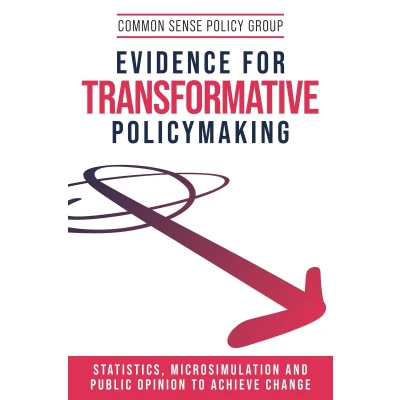
This textbook offers a unique, practical guide to using quantitative evidence for transformative policymaking in an era of crisis. Written by the Common Sense Policy Group at Northumbria University, it combines economic microsimulation, public opinion research and narrative persuasion to address Britain's deepest challenges. This Common Sense Policy Group textbook provides a comprehensive, interdisciplinary guide to developing quantitative evidence for transformative policymaking. Situated within the context of Britain’s interconnected social, economic and public health crises, it argues that effective progressive policymaking demands technical proficiency in statistical analysis alongside critical engagement with public opinion and narrative persuasion. The book progresses from foundational principles of quantitative research design through to advanced applied methods. Early chapters establish core competencies in working with large-sample UK datasets, understanding measures of poverty and inequality and building tax-benefit microsimulation models using Python. Subsequent chapters demonstrate advanced microsimulation capabilities, including distributional analysis of austerity-era policy changes and modelling of Basic Income schemes showing dramatic poverty reductions and progressive distributional effects. The textbook extends conventional economic microsimulation by integrating epidemiological modelling to estimate health impacts of fiscal reforms, using within–between regression models to establish causal relationships between income and health outcomes, before estimating cases of depression and physical illness prevented, Quality-Adjusted Life Years gained and associated NHS cost savings across multiple Basic Income scheme variants. The final chapters address the critical challenge of social feasibility. Using conjoint experiments, the book reveals public willingness to accept higher taxation when poverty reduction is substantial, challenging assumptions about the limits of the Overton Window. The textbook culminates by describing adversarial co-production – an innovative method adapting adversarial collaboration from behavioural science to develop persuasive policy narratives with firm policy opponents, demonstrating statistically significant increases in support among initially resistant participants. Together, these methods constitute a unified toolkit – operationalised through the Public Policy Preference Calculator (TriplePC) – for producing compelling, integrated evidence capable of influencing policymakers towards transformative reform. This textbook offers a unique, practical guide to using quantitative evidence for transformative policymaking in an era of crisis. Written by the Common Sense Policy Group at Northumbria University, it combines economic microsimulation, public opinion research and narrative persuasion to address Britain's deepest challenges: poverty, inequality, declining health and crumbling infrastructure.Unlike traditional policy texts, this book equips readers to develop their own tax-benefit modelling, conduct sophisticated distributional analysis, assess health impacts of economic interventions and use adversarial co-production to persuade policymakers. Using open-source tools, datasets and hands-on exercises and cases studies, it demonstrates that radical policies like Basic Income are both affordable and popular when properly evidenced and communicated.This enables readers to produce compelling evidence that can shift the ‘Overton Window’ and influence policymakers. It is essential reading for anyone seeking to rebuild Britain through evidence-based policy.
 Prijshistorie
 * Prijshistorie bevat geen data van Amazon, Amazon Marketplace.
Prijzen voor het laatst bijgewerkt op:
 Gerelateerde resultaten
 Productspecificaties


