

€ 127,50 Gratis verzending

Uitgelicht
|
|
127,50 |
Naar shop
|

|
127,50 |
Naar shop
|

|
147,05 |
Naar shop
|
| VERGELIJK ALLE AANBIEDERS (3) | ||
 Beschrijving
Vergelijk aanbieders (3)
€ 127,50 Gratis verzending
€ 127,50 Gratis verzending
€ 147,05 Gratis verzending
Winkels met andere maten
Beschrijving
(1)
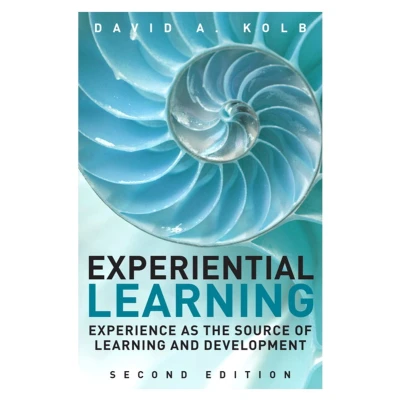
David A. Kolb’s Definitive Statement of Experiential Learning Theory (ELT): Reflecting 30 Years of New Research and Theoretical Advances A complete structural model of learning, integrating modern insights from psychology, philosophy, and physiology Ranges from ELT’s history to its newest applications in higher education and lifelong learning Introduces the powerful nine-style Kolb Learning Style Inventory 4.0 with assessment of learning flexibility In this revised edition of Experiential Learning, David A. Kolb offers the most complete and up-to-date statement of Experiential Learning Theory (ELT), an approach that has shaped the fields of human learning and development for decades. Kolb adds new research and reflections at the end of each chapter, preserving his original theory while illuminating key advances and theoretical issues raised during the past 30 years. After reviewing ELT’s historical roots, Kolb turns to contemporary applications in education, organization and management development, and adult learning. Next, he introduces a structured model of the learning process based on two key dimensions: prehension and transformation. Kolb explores new linkages between ELT and modern research into neuroscience, learning styles, and personal types; and introduces his improved Kolb Learning Style Inventory 4.0 assessment. Finally, he shares important new insights into adult development, specialization in higher education, and integrative development for lifelong learning. Experiential learning is a singularly powerful approach to teaching and learning that is based on the fact that people learn best through experience. Now, in this extensively updated book, David A. Kolb offers the most complete and up-to-date statement of the theory of experiential learning and its modern applications in education, work, and adult development. Experiential Learning, Second Edition builds on intellectual origins defined by figures such as William James, John Dewey, Kurt Lewin, Jean Piaget, and L. S. Vygotsky, while also reflecting three full decades of research and practice since the classic first edition. Kolb models underlying structures of learning based on the latest insights in psychology, philosophy, and physiology. Building on a comprehensive learning cycle model, he offers an exceptionally useful typology of nine individual learning styles, and corresponding structures of knowledge in diverse academic disciplines and careers. He also applies experiential learning to higher education and lifelong learning, especially with regard to adult education. This edition reviews recent applications of experiential learning, updates Kolb’s framework for today’s organizational and educational landscape, and features new examples in the field and classroom. It will be valuable for anyone who wants to improve learning anywhere: in higher education, training, organizational development, lifelong learning environments, and online. New reflections on the roots, history, and future of ELTProgress on the trail blazed by James, Dewey, Follett, and Vygotsky Learning cycles and learning spirals: a dynamic view of human learningLearning by resolving the dual dialectics of action/reflection and experience/abstraction Nine learning styles: the Kolb Learning Style Inventory 4.0Reliably identifying learning styles and learning flexibility based on 30+ years of empirical and clinical research Becoming an experiential educatorFinding a better way to help learners learn Experiential learning is a powerful and proven approach to teaching and learning that is based on one incontrovertible reality: people learn best through experience. Now, in this extensively updated book, David A. Kolb offers a systematic and up-to-date statement of the theory of experiential learning and its modern applications to education, work, and adult development. Experiential Learning, Second Edition builds on the intellectual origins of experiential learning as defined by figures such as John Dewey, Kurt Lewin, Jean Piaget, and L.S. Vygotsky, while also reflecting three full decades of research and practice since the classic first edition. Kolb models the underlying structures of the learning process based on the latest insights in psychology, philosophy, and physiology. Building on his comprehensive structural model, he offers an exceptionally useful typology of individual learning styles and corresponding structures of knowledge in different academic disciplines and careers. Kolb also applies experiential learning to higher education and lifelong learning, especially with regard to adult education. This edition reviews recent applications and uses of experiential learning, updates Kolb's framework to address the current organizational and educational landscape, and features current examples of experiential learning both in the field and in the classroom. It will be an indispensable resource for everyone who wants to promote more effective learning: in higher education, training, organizational development, lifelong learning environments, and online.
 Prijshistorie
 * Prijshistorie bevat geen data van Amazon, Amazon Marketplace.
Prijzen voor het laatst bijgewerkt op:
 Gerelateerde resultaten
 Productspecificaties


