
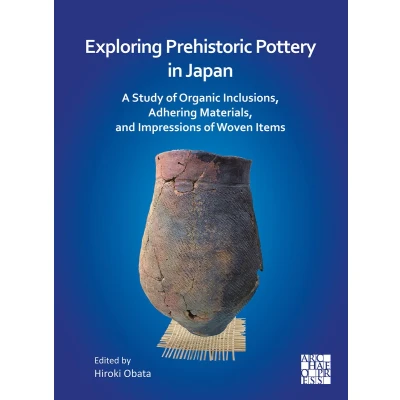
Exploring Prehistoric Pottery in Japan: A Study of Organic Inclusions, Adhering Materials, and Impressions Woven Items
Uitgelicht

|
34,99 |
Naar shop
|

|
38,23 |
Naar shop
|

|
38,23 |
Naar shop
|
| VERGELIJK ALLE AANBIEDERS (3) | ||
 Beschrijving
Bol
This volume explores how scientific analysis of Jōmon and Yayoi pottery reveals evidence of prehistoric life. Examining plant remains, tool impressions, food residues and carbonised traces, it demonstrates how “excavating inside the pottery” can reconstruct ancient lifeways, technologies and environments. Jōmon pottery is globally renowned for its lavish ornamentation and functional beauty. Beyond its aesthetic value, this pottery serves as a crucial archaeological archive, preserving microscopic traces of prehistoric life. Recent interdisciplinary research reveals that cultivated plants, household pests, and plant-based tempering agents left distinct imprints and voids within the clay fabric. Furthermore, impressions of woven mats and fishing nets provide direct evidence of the tools and materials used in vessel construction. Organic substances and carbonised residues absorbed by the pottery during usage enable the identification of ancient foodstuffs and medicinal plants, while also providing materials for precise radiocarbon dating, alongside carbonised inclusions. Collaboratively termed ‘excavating inside the pottery’, this scientific approach reconstructs past lifeways through artefactual analysis. This volume presents the theoretical framework of this methodology, along with illustrative, empirical case studies from Jōmon and Yayoi pottery.


 Beschrijving
(1)
Beschrijving
(1)
This volume explores how scientific analysis of Jōmon and Yayoi pottery reveals evidence of prehistoric life. Examining plant remains, tool impressions, food residues and carbonised traces, it demonstrates how “excavating inside the pottery” can reconstruct ancient lifeways, technologies and environments. Jōmon pottery is globally renowned for its lavish ornamentation and functional beauty. Beyond its aesthetic value, this pottery serves as a crucial archaeological archive, preserving microscopic traces of prehistoric life. Recent interdisciplinary research reveals that cultivated plants, household pests, and plant-based tempering agents left distinct imprints and voids within the clay fabric. Furthermore, impressions of woven mats and fishing nets provide direct evidence of the tools and materials used in vessel construction. Organic substances and carbonised residues absorbed by the pottery during usage enable the identification of ancient foodstuffs and medicinal plants, while also providing materials for precise radiocarbon dating, alongside carbonised inclusions. Collaboratively termed ‘excavating inside the pottery’, this scientific approach reconstructs past lifeways through artefactual analysis. This volume presents the theoretical framework of this methodology, along with illustrative, empirical case studies from Jōmon and Yayoi pottery.
 Productspecificaties
 Prijshistorie
* Prijshistorie bevat geen data van Amazon, Amazon Marketplace.
Prijzen voor het laatst bijgewerkt op:
 Gerelateerde resultaten


