
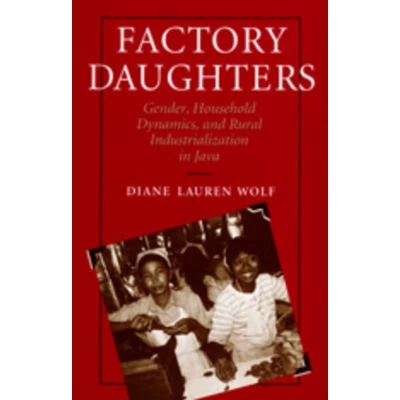
Factory Daughters
Uitgelicht

|
11,95 |
Naar shop
|
| VERGELIJK ALLE AANBIEDERS (1) | ||
 Beschrijving
Bol Partner
Looking at the households where Javanese women live and the factories where they labour, Diane Wolf reveals the contradictions, constraints and changes in women's lives in the Third World and identifies the complex dynamics of class, gender, agrarian change and industrialization in rural Java. "The book is both theoretically sophisticated and empirically rich. Wolf draws effectively on scholarship ranging from historiography about early modern Europe to recent analyses of the economic conduct of peasant families in contemporary Asia or Latin America. . . . Wolf tells wonderful stories about vibrant, even irrevent, young women." --Frances Gouda, Women's Review of Books "Wolf's fine study is a model of theoretically self-conscious, empirically-grounded feminist scholarship on Third World women. She forces a bracing reexamination of received wisdom on household strategies, patriarchy, proletarianization, gender relations, the life, cycle, and the impact of factory work on agrarian societies." --James C. Scott, Yale University "The author does an excellent job of blending together qualitative interview material with more quantitative survey analysis when the latter is appropriate. This work will be a significant contribution to a number of fields." --Carmen Diana Deere, author of Household and Class Relations "Offers a wealth of important insights on changing gender roles in Southeast Asia, on the analysis of household economies, and on international processes of industrialization." --Choice Taking the reader inside the households where Javanese women live and the factories where they labour, Diane Wolf reveals the contradictions, constraints and changes in women's lives in the Third World. She debunks conventional wisdom about the patriarchal family, while at the same time clearly identifying the complex dynamics of class, gender, agrarian change and industrialization in rural Java. "Factory Daughters" is distinguished by wide-ranging fieldwork in Java and a combination of narratives, rigorous surveys and quantitative analysis. In bringing us the words of many Javanese women, Wolf is able to vividly portray the ways they negotiate employment, income and marriage decisions through the webs of family obligations. The result is an original, effective contribution that deepens our understanding of industrialization and family life in the Third World.


Vergelijk aanbieders (1)

 Beschrijving
(1)
Beschrijving
(1)
Looking at the households where Javanese women live and the factories where they labour, Diane Wolf reveals the contradictions, constraints and changes in women's lives in the Third World and identifies the complex dynamics of class, gender, agrarian change and industrialization in rural Java. "The book is both theoretically sophisticated and empirically rich. Wolf draws effectively on scholarship ranging from historiography about early modern Europe to recent analyses of the economic conduct of peasant families in contemporary Asia or Latin America. . . . Wolf tells wonderful stories about vibrant, even irrevent, young women." --Frances Gouda, Women's Review of Books "Wolf's fine study is a model of theoretically self-conscious, empirically-grounded feminist scholarship on Third World women. She forces a bracing reexamination of received wisdom on household strategies, patriarchy, proletarianization, gender relations, the life, cycle, and the impact of factory work on agrarian societies." --James C. Scott, Yale University "The author does an excellent job of blending together qualitative interview material with more quantitative survey analysis when the latter is appropriate. This work will be a significant contribution to a number of fields." --Carmen Diana Deere, author of Household and Class Relations "Offers a wealth of important insights on changing gender roles in Southeast Asia, on the analysis of household economies, and on international processes of industrialization." --Choice Taking the reader inside the households where Javanese women live and the factories where they labour, Diane Wolf reveals the contradictions, constraints and changes in women's lives in the Third World. She debunks conventional wisdom about the patriarchal family, while at the same time clearly identifying the complex dynamics of class, gender, agrarian change and industrialization in rural Java. "Factory Daughters" is distinguished by wide-ranging fieldwork in Java and a combination of narratives, rigorous surveys and quantitative analysis. In bringing us the words of many Javanese women, Wolf is able to vividly portray the ways they negotiate employment, income and marriage decisions through the webs of family obligations. The result is an original, effective contribution that deepens our understanding of industrialization and family life in the Third World.
 Productspecificaties
| EAN |
|
|---|---|
| Maat |
|
 Prijshistorie
Prijzen voor het laatst bijgewerkt op:
 Gerelateerde resultaten


