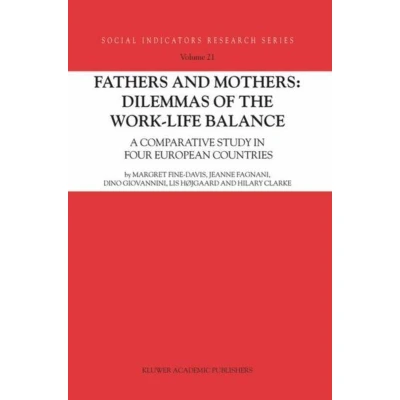

Fathers and Mothers: Dilemmas of the Work Life Balance

Prijzen vanaf
91,99

Uitgelicht

Beschrijving

Bol At the risk of sounding frivolous, there is a good case to be made for the argument that women constitute the revolutionary force behind contemporary social and economic transformation. At the risk of sounding frivolous, there is a good case to be made for the argument that women constitute the revolutionary force behind contemporary social and economic transformation. It is in large part the changing role of women that explains the new household structure, our altered demographic behaviour, the growth of the service economy and, as a consequence, the new dilemmas that the advanced societies face. Most European countries have failed to adapt adequately to the novel challenges and the result is an increasingly serious disequilibrium. Women explicitly desire economic independence and the societal collective, too, needs to maximise female employment. And yet, this runs up against severe incompatibility problems that then result in very low birth rates. Our aging societies need more kids, yet fertility levels are often only half of what citizens define as their desired number of children. No matter what happens in the next decade, we are doomed to have exceedingly small cohorts that, in turn, must shoulder the massive burden of supporting a retired baby-boom generation. Hence it is tantamount that tomorrow’s adults be maximally productive and, yet, the typical EU member state invests very little in its children and families.

Vergelijk aanbieders (1)

Shop
Prijs
Verzendkosten
Totale prijs
91,99
Gratis
91,99
Naar shop
Gratis Shipping Costs
Beschrijving (1)

At the risk of sounding frivolous, there is a good case to be made for the argument that women constitute the revolutionary force behind contemporary social and economic transformation. At the risk of sounding frivolous, there is a good case to be made for the argument that women constitute the revolutionary force behind contemporary social and economic transformation. It is in large part the changing role of women that explains the new household structure, our altered demographic behaviour, the growth of the service economy and, as a consequence, the new dilemmas that the advanced societies face. Most European countries have failed to adapt adequately to the novel challenges and the result is an increasingly serious disequilibrium. Women explicitly desire economic independence and the societal collective, too, needs to maximise female employment. And yet, this runs up against severe incompatibility problems that then result in very low birth rates. Our aging societies need more kids, yet fertility levels are often only half of what citizens define as their desired number of children. No matter what happens in the next decade, we are doomed to have exceedingly small cohorts that, in turn, must shoulder the massive burden of supporting a retired baby-boom generation. Hence it is tantamount that tomorrow’s adults be maximally productive and, yet, the typical EU member state invests very little in its children and families.


Productspecificaties

EAN
  • 9781402018480
  • 9781402018077
Maat


Prijshistorie

Prijzen voor het laatst bijgewerkt op:

Uitgelichte Keuze
91,99
Naar shop
