
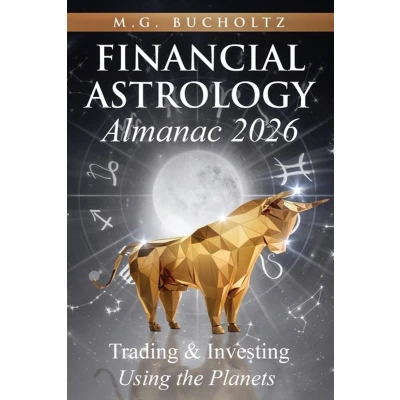
Financial Astrology Almanac 2026: Trading and Investing Using the Planets
Uitgelicht

|
16,00 |
Naar shop
|

|
17,43 |
Naar shop
|

|
17,43 |
Naar shop
|
| VERGELIJK ALLE AANBIEDERS (3) | ||
 Beschrijving
Bol
The recognition of the connection between planetary movement and the markets is not a new one. In the early 1900s, successful traders like W.D. Gann, J.P. Morgan, Professor Weston, and the mysterious Louise McWhirter recognized that bullish and bearish price trends on financial markets were closely related to planetary aspects and movements. By the late 1940s, Wall Street bankers were faced with the uncomfortable reality that this planetary connection was becoming too well known about by average investors. To combat this rising knowledge, leading academic finance figures came to Wall Street's rescue with theories and hypotheses such as Modern Portfolio Theory and the Efficient Market Hypothesis, designed to convince people that investing was about buying and holding for the long term and not trying to time the market ups and downs. This academic approach held firm until market meltdowns, in 2000 and again in 2008, made investors question the wisdom of this academic approach. Slowly, the use of astrology began to re-emerge from the shadows. Our solar system is a complex construct that functions with resonance and harmony. Research by astronomers and mathematicians over the past decade has shown that heliocentric planetary aspects and movements involving Mercury, Venus, Earth, Jupiter, and Saturn exert gravitational torque forces on the Sun. These forces create sunspots and the emission of solar wind energy particles. These energy emissions affect the Earth's weather patterns. The Financial Astrology Almanac 2026 first shows the reader that these same heliocentric aspects also affect our emotions. It is human emotion that drives buying and selling behavior across equity and commodity markets. This book provides the reader with key dates that stand to influence price trends on the S&P 500 and Nasdaq, as well as on metals, grains, currencies, and soft commodities futures. The Almanac then introduces the reader to price cycles related to the orbital periods and axial spin time of the planets that further contribute to the highs, lows, and pivot points across equity and commodity futures markets. Malcolm Bucholtz, B.Sc., MBA, M.Sc., resides in western Canada where he trades the financial markets using technical chart analysis, esoteric mathematics and astrology. Through his website , he offers the Astrology Letter and the Cycle Report that keep subscribers apprised of pending astrological events and cyclical intervals that stand to influence markets.


 Beschrijving
(1)
Beschrijving
(1)
The recognition of the connection between planetary movement and the markets is not a new one. In the early 1900s, successful traders like W.D. Gann, J.P. Morgan, Professor Weston, and the mysterious Louise McWhirter recognized that bullish and bearish price trends on financial markets were closely related to planetary aspects and movements. By the late 1940s, Wall Street bankers were faced with the uncomfortable reality that this planetary connection was becoming too well known about by average investors. To combat this rising knowledge, leading academic finance figures came to Wall Street's rescue with theories and hypotheses such as Modern Portfolio Theory and the Efficient Market Hypothesis, designed to convince people that investing was about buying and holding for the long term and not trying to time the market ups and downs. This academic approach held firm until market meltdowns, in 2000 and again in 2008, made investors question the wisdom of this academic approach. Slowly, the use of astrology began to re-emerge from the shadows. Our solar system is a complex construct that functions with resonance and harmony. Research by astronomers and mathematicians over the past decade has shown that heliocentric planetary aspects and movements involving Mercury, Venus, Earth, Jupiter, and Saturn exert gravitational torque forces on the Sun. These forces create sunspots and the emission of solar wind energy particles. These energy emissions affect the Earth's weather patterns. The Financial Astrology Almanac 2026 first shows the reader that these same heliocentric aspects also affect our emotions. It is human emotion that drives buying and selling behavior across equity and commodity markets. This book provides the reader with key dates that stand to influence price trends on the S&P 500 and Nasdaq, as well as on metals, grains, currencies, and soft commodities futures. The Almanac then introduces the reader to price cycles related to the orbital periods and axial spin time of the planets that further contribute to the highs, lows, and pivot points across equity and commodity futures markets. Malcolm Bucholtz, B.Sc., MBA, M.Sc., resides in western Canada where he trades the financial markets using technical chart analysis, esoteric mathematics and astrology. Through his website , he offers the Astrology Letter and the Cycle Report that keep subscribers apprised of pending astrological events and cyclical intervals that stand to influence markets.
 Productspecificaties
 Prijshistorie
* Prijshistorie bevat geen data van Amazon, Amazon Marketplace.
Prijzen voor het laatst bijgewerkt op:
 Gerelateerde resultaten


