
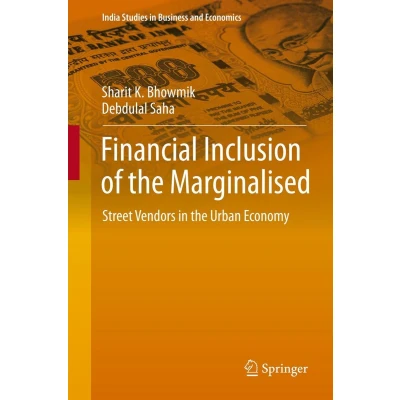
Financial Inclusion of the Marginalised
Uitgelicht

|
92,99 |
Naar shop
|
| VERGELIJK ALLE AANBIEDERS (1) | ||
 Beschrijving
Bol
Its objective is to highlight some of the problems faced by street vendors in conducting their daily business and to examine how financial institutions, especially those in the banking sector, can include street vendors in their credit policies. This book is the product of a study conducted by the Tata Institute of Social Sciences (TISS) in collaboration with the United Nations Development Programme (UNDP) and Ministry of Urban Housing and Poverty Alleviation (MoHUPA). Its objective is to highlight some of the problems faced by street vendors in conducting their daily business and to examine how financial institutions, especially those in the banking sector, can include street vendors in their credit policies. Data was collected from 15 cities across the country. Not surprisingly, while issues such as public space utilisation have been deliberated upon at length, those concerning the nature of credit transactions and concurrently the financial inclusion of street vendors have scarcely received focussed attention. In the absence of formal credit, street vendors largely depend on loan sharks, who charge high interest rates ranging from 350% to 800% per annum. The problem of formal credit aside, another equally important factoris the inflexible attitude of the civic authorities towards street vending. Given their informal status, this is particularly apparent because they are forced to conduct business in the absence of legal protection, making them vulnerable to rent seeking by the authorities. The acceptance of the National Policy for Urban Street Vendors by a few states and the subsequent bill to protect the livelihood of street vendors should help them gain legitimacy and subsequently credit to run their businesses at proper rates. The book examines and analyses these issues. This book is the product of a study conducted by the Tata Institute of Social Sciences (TISS) in collaboration with the United Nations Development Programme (UNDP) and Ministry of Urban Housing and Poverty Alleviation (MoHUPA). Its objective is to highlight some of the problems faced by street vendors in conducting their daily business and to examine how financial institutions, especially those in the banking sector, can include street vendors in their credit policies. Data was collected from 15 cities across the country. Not surprisingly, while issues such as public space utilisation have been deliberated upon at length, those concerning the nature of credit transactions and concurrently the financial inclusion of street vendors have scarcely received focussed attention. In the absence of formal credit, street vendors largely depend on loan sharks, who charge high interest rates ranging from 350% to 800% per annum. The problem of formal credit aside, another equally important factoris the inflexible attitude of the civic authorities towards street vending. Given their informal status, this is particularly apparent because they are forced to conduct business in the absence of legal protection, making them vulnerable to rent seeking by the authorities. The acceptance of the National Policy for Urban Street Vendors by a few states and the subsequent bill to protect the livelihood of street vendors should help them gain legitimacy and subsequently credit to run their businesses at proper rates. The book examines and analyses these issues.


Vergelijk aanbieders (1)

 Beschrijving
(1)
Beschrijving
(1)
Its objective is to highlight some of the problems faced by street vendors in conducting their daily business and to examine how financial institutions, especially those in the banking sector, can include street vendors in their credit policies. This book is the product of a study conducted by the Tata Institute of Social Sciences (TISS) in collaboration with the United Nations Development Programme (UNDP) and Ministry of Urban Housing and Poverty Alleviation (MoHUPA). Its objective is to highlight some of the problems faced by street vendors in conducting their daily business and to examine how financial institutions, especially those in the banking sector, can include street vendors in their credit policies. Data was collected from 15 cities across the country. Not surprisingly, while issues such as public space utilisation have been deliberated upon at length, those concerning the nature of credit transactions and concurrently the financial inclusion of street vendors have scarcely received focussed attention. In the absence of formal credit, street vendors largely depend on loan sharks, who charge high interest rates ranging from 350% to 800% per annum. The problem of formal credit aside, another equally important factoris the inflexible attitude of the civic authorities towards street vending. Given their informal status, this is particularly apparent because they are forced to conduct business in the absence of legal protection, making them vulnerable to rent seeking by the authorities. The acceptance of the National Policy for Urban Street Vendors by a few states and the subsequent bill to protect the livelihood of street vendors should help them gain legitimacy and subsequently credit to run their businesses at proper rates. The book examines and analyses these issues. This book is the product of a study conducted by the Tata Institute of Social Sciences (TISS) in collaboration with the United Nations Development Programme (UNDP) and Ministry of Urban Housing and Poverty Alleviation (MoHUPA). Its objective is to highlight some of the problems faced by street vendors in conducting their daily business and to examine how financial institutions, especially those in the banking sector, can include street vendors in their credit policies. Data was collected from 15 cities across the country. Not surprisingly, while issues such as public space utilisation have been deliberated upon at length, those concerning the nature of credit transactions and concurrently the financial inclusion of street vendors have scarcely received focussed attention. In the absence of formal credit, street vendors largely depend on loan sharks, who charge high interest rates ranging from 350% to 800% per annum. The problem of formal credit aside, another equally important factoris the inflexible attitude of the civic authorities towards street vending. Given their informal status, this is particularly apparent because they are forced to conduct business in the absence of legal protection, making them vulnerable to rent seeking by the authorities. The acceptance of the National Policy for Urban Street Vendors by a few states and the subsequent bill to protect the livelihood of street vendors should help them gain legitimacy and subsequently credit to run their businesses at proper rates. The book examines and analyses these issues.
 Productspecificaties
| EAN |
|
|---|---|
| Maat |
|
 Prijshistorie
Prijzen voor het laatst bijgewerkt op:
 Gerelateerde resultaten


