
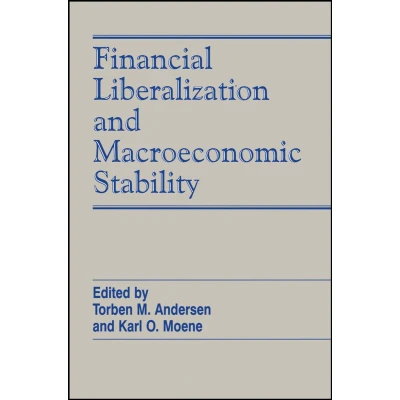
Financial Liberalization and Macroeconomic Stability
Uitgelicht

|
28,93 |
Naar shop
|
| VERGELIJK ALLE AANBIEDERS (1) | ||
 Beschrijving
Bol
aeo A topical subject of concern to all European countries. aeo The subject is addressed by a collection of top ranking economists with emphasis on real world policy. aeo This book is part of the well established SJE series and so quality is guaranteed. Most advanced countries have recently deregulated their credit markets and international capital movements have been liberalized. Over the same period, we have also experienced volatile financial markets and exchange rate crises, particularly in a number of European countries. This naturally raises the question of whether financial liberalization has affected macroeconomic stability and, if so, through which channels. As capital markets are liberalized, exchange rate crises may become more contagious. Empirical evidence indicates that this has been underlying the recent crises in the European currency market. This phenomenon has renewed our interest in the fundamental factors determining credibility of exchange rate policies and whether a Tobin tax on foreign exchange transactions could mute speculative pressure and stabilize the international monetary system. Macroeconomic stability towards different types of shocks may change as a result of both further capital market integration and monetary arrangements related to exchange rate management. This also raises the question of how the choice of operating targets for monetary policy affects macroeconomic stability. Seen from a single country perspective, capital market liberalization has had its most important effects by facilitating households' access to credit markets and opening up financial markets to foreign investors. This volume brings together theoretical and empirical contributions addressing these issues. This volume examines the causes of the very volatile financial markets and exchange rate crises recently experienced, particularly in a number of European countries, and considers the implications for business cycle fluctuations and economic policy. It will attempt to clarify whether these developments can be attributed to further capital market liberalization, financial innovations, etc., or whether they are the product of business cycle changes in combination with shifts in the focus of economic policy towards less activism and low inflation. Issues related to the functioning of financial and exchange rate markets, the possibility of controlling these markets, the gains from liberalization and the implications for economic policy will also be covered.


Vergelijk aanbieders (1)

 Beschrijving
(1)
Beschrijving
(1)
aeo A topical subject of concern to all European countries. aeo The subject is addressed by a collection of top ranking economists with emphasis on real world policy. aeo This book is part of the well established SJE series and so quality is guaranteed. Most advanced countries have recently deregulated their credit markets and international capital movements have been liberalized. Over the same period, we have also experienced volatile financial markets and exchange rate crises, particularly in a number of European countries. This naturally raises the question of whether financial liberalization has affected macroeconomic stability and, if so, through which channels. As capital markets are liberalized, exchange rate crises may become more contagious. Empirical evidence indicates that this has been underlying the recent crises in the European currency market. This phenomenon has renewed our interest in the fundamental factors determining credibility of exchange rate policies and whether a Tobin tax on foreign exchange transactions could mute speculative pressure and stabilize the international monetary system. Macroeconomic stability towards different types of shocks may change as a result of both further capital market integration and monetary arrangements related to exchange rate management. This also raises the question of how the choice of operating targets for monetary policy affects macroeconomic stability. Seen from a single country perspective, capital market liberalization has had its most important effects by facilitating households' access to credit markets and opening up financial markets to foreign investors. This volume brings together theoretical and empirical contributions addressing these issues. This volume examines the causes of the very volatile financial markets and exchange rate crises recently experienced, particularly in a number of European countries, and considers the implications for business cycle fluctuations and economic policy. It will attempt to clarify whether these developments can be attributed to further capital market liberalization, financial innovations, etc., or whether they are the product of business cycle changes in combination with shifts in the focus of economic policy towards less activism and low inflation. Issues related to the functioning of financial and exchange rate markets, the possibility of controlling these markets, the gains from liberalization and the implications for economic policy will also be covered.
 Productspecificaties
| EAN |
|
|---|---|
| Maat |
|
 Prijshistorie
Prijzen voor het laatst bijgewerkt op:
 Gerelateerde resultaten


