
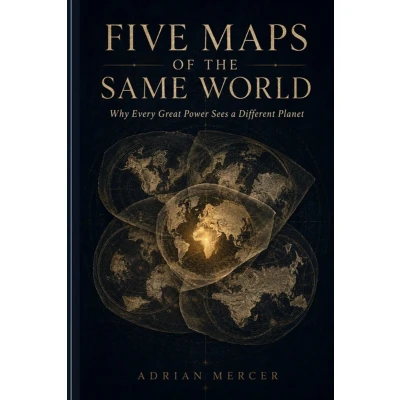
Five Maps of the Same World: Why Every Great Power Sees a Different Planet
Uitgelicht

|
21,11
16,00 |
Naar shop
|

|
22,28 |
Naar shop
|

|
22,28 |
Naar shop
|
| VERGELIJK ALLE AANBIEDERS (3) | ||
 Beschrijving
Bol
Five great powers. One planet. Five completely different maps of it. Every night the news tells you what happened. It almost never tells you why five capitals just drew five opposite conclusions from the very same event. Five Maps of the Same World is the field guide to that gap - a walk through the minds of the powers that run the twenty-first century: China, the United States, Russia, Europe, and India. You step into five rooms, and on the wall of each hangs a map of the same earth. None of them match. The organizing question is not the one most books ask. Not what does each power want? - wants are public relations. It is what does each power fear? Fear is the most honest engine in geopolitics: it is what survives when the speeches end and the decisions get made at three in the morning. Across eight fault lines - energy, the seas, the microchips, the dollar, spheres of influence, the melting Arctic, the Global South, and the demographic clock - you don't collect opinions to agree or disagree with. You collect eight portable lenses for reading any headline that lands, today or ten years from now: - Follow the chokepoint- Every map is drawn from a coastline- Find the single point of failure- Whoever owns the pipes sets the rules- Map the hypocrisy- Watch who rushes first- Ask who the undecided majority is courting- Read the age pyramid - time is the one map no power can redraw Then you put the lenses to work. In Part Two, six conditional war-games - a blockade of Taiwan, an American retreat from the world, a Russia falling into China's arms, a crack in the petrodollar, India's decade of decision, and whether artificial intelligence rewrites the demographic clock - are played out move by move, with the tools of game theory and the cold clarity of a strategist. Not predictions. Practice. By the last page you will no longer simply react to the news. You will walk, in your mind, into the room it is being read from, find the fear beneath the fact, and judge for yourself - with clear eyes and a steady conscience. For readers of Tim Marshall, Peter Zeihan, and Robert Kaplan - and for anyone who has ever finished a news report and thought: but why? This book does not tell you what to see. It teaches you how to look.


 Beschrijving
(1)
Beschrijving
(1)
Five great powers. One planet. Five completely different maps of it. Every night the news tells you what happened. It almost never tells you why five capitals just drew five opposite conclusions from the very same event. Five Maps of the Same World is the field guide to that gap - a walk through the minds of the powers that run the twenty-first century: China, the United States, Russia, Europe, and India. You step into five rooms, and on the wall of each hangs a map of the same earth. None of them match. The organizing question is not the one most books ask. Not what does each power want? - wants are public relations. It is what does each power fear? Fear is the most honest engine in geopolitics: it is what survives when the speeches end and the decisions get made at three in the morning. Across eight fault lines - energy, the seas, the microchips, the dollar, spheres of influence, the melting Arctic, the Global South, and the demographic clock - you don't collect opinions to agree or disagree with. You collect eight portable lenses for reading any headline that lands, today or ten years from now: - Follow the chokepoint- Every map is drawn from a coastline- Find the single point of failure- Whoever owns the pipes sets the rules- Map the hypocrisy- Watch who rushes first- Ask who the undecided majority is courting- Read the age pyramid - time is the one map no power can redraw Then you put the lenses to work. In Part Two, six conditional war-games - a blockade of Taiwan, an American retreat from the world, a Russia falling into China's arms, a crack in the petrodollar, India's decade of decision, and whether artificial intelligence rewrites the demographic clock - are played out move by move, with the tools of game theory and the cold clarity of a strategist. Not predictions. Practice. By the last page you will no longer simply react to the news. You will walk, in your mind, into the room it is being read from, find the fear beneath the fact, and judge for yourself - with clear eyes and a steady conscience. For readers of Tim Marshall, Peter Zeihan, and Robert Kaplan - and for anyone who has ever finished a news report and thought: but why? This book does not tell you what to see. It teaches you how to look.
 Productspecificaties
 Prijshistorie
* Prijshistorie bevat geen data van Amazon, Amazon Marketplace.
Prijzen voor het laatst bijgewerkt op:
 Gerelateerde resultaten


