


€ 69,99 Gratis verzending

Uitgelicht
|
|
69,99 |
Naar shop
|

|
73,32 |
Naar shop
|

|
73,32 |
Naar shop
|
| VERGELIJK ALLE AANBIEDERS (3) | ||
 Beschrijving
Vergelijk aanbieders (3)
€ 69,99 Gratis verzending
€ 73,32 Gratis verzending
€ 73,32 Gratis verzending
Winkels met andere maten
Beschrijving
(1)
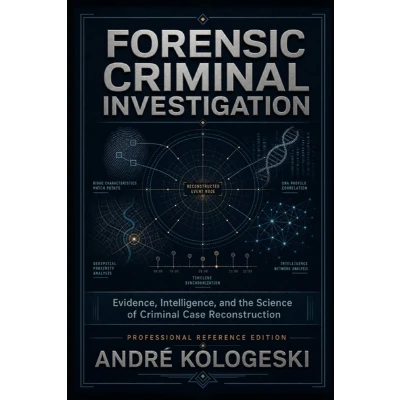
A criminal case is not solved by collecting the greatest number of facts. It is solved by determining what each fact establishes, how reliable the method is, whether apparently separate findings share the same source, and which explanation best survives disciplined attempts at falsification. Forensic Criminal Investigation is a field-to-court reference for professionals who need to reconstruct events from incomplete, multidisciplinary evidence without overstating certainty. André Kologeski brings crime-scene intelligence, biological evidence, bloodstain pattern analysis, fingerprints, trace evidence, firearms and toolmarks, digital forensics, investigative interviewing, behavioral evidence, timeline analysis, geospatial intelligence, link analysis, and Bayesian reasoning into one transparent reconstruction system. Across 24 chapters, the book shows readers how to: 1. distinguish observation, inference, hypothesis, and speculation; 2. evaluate foundational validity, applied validity, error, transfer, persistence, and uncertainty; 3. preserve physical and digital evidence through traceable chains of custody; 4. build timelines, evidence maps, dependency registers, and competing-hypothesis matrices; 5. recognize contextual bias, tunnel vision, confirmation bias, and false corroboration; 6. integrate biological, physical, digital, testimonial, behavioral, documentary, financial, and geospatial findings without double counting; 7. communicate conclusions in disciplined language that identifies assumptions, limitations, and unresolved questions; and 8. apply a professional criminal case reconstruction protocol that remains reviewable from first response through final reporting. The Professional Reference Edition includes original analytical diagrams, recurring myth-versus- research and practical-implication boxes, documented case studies, critical-thinking questions, an 11- form Forensic Case Reconstruction Workbench, nine professional appendices, a specialized glossary, and an extensive subject index. Designed for investigators, forensic practitioners, intelligence analysts, attorneys, private investigators, academics, and advanced students, this volume treats forensic science as a system of accountable reasoning rather than a collection of dramatic techniques. It is built for readers who must know not only what an item of evidence may support, but also what it cannot establish on its own. Evidence becomes intelligence only when its provenance is protected, its limitations are disclosed, its dependencies are controlled, and its meaning is tested against credible alternatives.
 Prijshistorie
 * Prijshistorie bevat geen data van Amazon, Amazon Marketplace.
Prijzen voor het laatst bijgewerkt op:
 Gerelateerde resultaten
 Productspecificaties


