
Framing The Clue Puzzle: Paratextual Voice in Golden Age Detective Fiction
Uitgelicht

|
100,50 |
Naar shop
|

|
100,50 |
Naar shop
|

|
111,00 |
Naar shop
|
| VERGELIJK ALLE AANBIEDERS (3) | ||
 Beschrijving
Bol
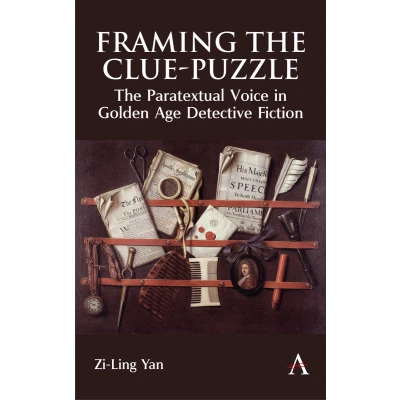
In Framing the Clue-Puzzle Zi-Ling Yan investigates the semiotization of fictive paratexts in interwar Anglo-American detective fiction, and the means by which they subtly frame ideological positions within major mystery fiction themes, such as justice and normative notions of criminality. Zi-Ling Yan’s Framing the Clue Puzzle examines a familiar but unsystematically addressed and understudied feature of much Golden Age detective fiction: the conscious incorporation of paratexts into the mystery narrative. After examining Gérard Genette’s pioneering work on paratexts and recent criticism concerned with their literary applications, Yan draws upon Dan Sperber and Deidre Wilson’s Relevance Theory and Richard Walsh’s notion of fictionality to develop an approach in which paratexts are understood to exert framing functions by implicature while, because they are subsumed in the text, only mimicking metalepsis. This understanding of the fictive paratext is then applied to a data set consisting of 530 detective narratives divided into five core chapters covering prefaces, footnotes, maps, floorplans, and diagrammatic devices. The results disclose consistent patterns of development between para- or intra-textual types over time and within subgenres: a trickle of paratextual material in the late nineteenth-century Classical period of the genre, notable increases during the 1920s, which peak the 1930s and subside in the 1940s, bracketing the Golden Age clue-puzzle. The chapter sequence is built upon several criteria: degree of paratextual independence or integration, physical placement, and the rhetorical aspects of voice evoked by the problem of the para-/intra-textual locus of enunciation. The movement is from detachable, more personalised elements visibly situated at the margin to increasingly anonymous figures which are more integrated and internal. The depersonalisation of voice coincides with the progressive obfuscation of agency and subtler dimensions of framing that evoke forms speaking as forms. Once brought to notice as objects to be studied rather than thresholds mutely registering as transmissive features of discourse, their incidence raises several questions pertaining to their historical appearance, to their normative framing capacity, and relatedly, to how they serve discursively as guarantors of content beyond their attribution to characters, narrators, or authors. In short, I show how in this capacity they are linked to the promotion of certain types of knowledge and concepts of justice contained in the pages they frame.


 Beschrijving
(1)
Beschrijving
(1)
In Framing the Clue-Puzzle Zi-Ling Yan investigates the semiotization of fictive paratexts in interwar Anglo-American detective fiction, and the means by which they subtly frame ideological positions within major mystery fiction themes, such as justice and normative notions of criminality. Zi-Ling Yan’s Framing the Clue Puzzle examines a familiar but unsystematically addressed and understudied feature of much Golden Age detective fiction: the conscious incorporation of paratexts into the mystery narrative. After examining Gérard Genette’s pioneering work on paratexts and recent criticism concerned with their literary applications, Yan draws upon Dan Sperber and Deidre Wilson’s Relevance Theory and Richard Walsh’s notion of fictionality to develop an approach in which paratexts are understood to exert framing functions by implicature while, because they are subsumed in the text, only mimicking metalepsis. This understanding of the fictive paratext is then applied to a data set consisting of 530 detective narratives divided into five core chapters covering prefaces, footnotes, maps, floorplans, and diagrammatic devices. The results disclose consistent patterns of development between para- or intra-textual types over time and within subgenres: a trickle of paratextual material in the late nineteenth-century Classical period of the genre, notable increases during the 1920s, which peak the 1930s and subside in the 1940s, bracketing the Golden Age clue-puzzle. The chapter sequence is built upon several criteria: degree of paratextual independence or integration, physical placement, and the rhetorical aspects of voice evoked by the problem of the para-/intra-textual locus of enunciation. The movement is from detachable, more personalised elements visibly situated at the margin to increasingly anonymous figures which are more integrated and internal. The depersonalisation of voice coincides with the progressive obfuscation of agency and subtler dimensions of framing that evoke forms speaking as forms. Once brought to notice as objects to be studied rather than thresholds mutely registering as transmissive features of discourse, their incidence raises several questions pertaining to their historical appearance, to their normative framing capacity, and relatedly, to how they serve discursively as guarantors of content beyond their attribution to characters, narrators, or authors. In short, I show how in this capacity they are linked to the promotion of certain types of knowledge and concepts of justice contained in the pages they frame.
 Productspecificaties
 Prijshistorie
* Prijshistorie bevat geen data van Amazon, Amazon Marketplace.
Prijzen voor het laatst bijgewerkt op:
 Gerelateerde resultaten


