
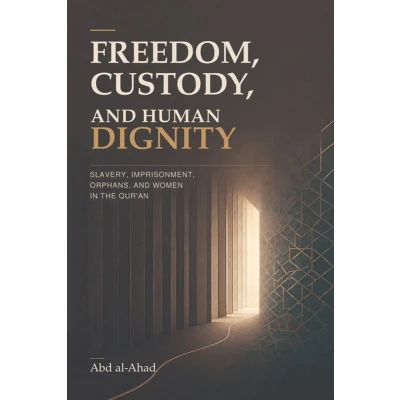
Freedom, Custody, and Human Dignity: Slavery, Imprisonment, Orphans, Women in the Qur’an
Uitgelicht

|
13,00 |
Naar shop
|

|
14,07 |
Naar shop
|

|
14,07 |
Naar shop
|
| VERGELIJK ALLE AANBIEDERS (3) | ||
 Beschrijving
Bol
Modern societies have made imprisonment their ordinary answer to wrongdoing-but does confinement restore justice, repair harm, or prepare a person to return responsibly to society?Freedom, Custody, and Human Dignity examines slavery, captivity, imprisonment, guardianship, and social protection through the moral framework of the Qur'an. Abd al-Ahad argues that the Qur'anic treatment of those held under another's authority cannot be understood simply through the later history of chattel slavery. Instead, its repeated commands of humane care, emancipation, contractual freedom, restitution, and social reintegration reveal a powerful movement away from permanent subjugation.The first part of the book confronts the emotional scars and social destruction caused by modern incarceration. It develops the concept of Penal Adaptation: a carefully supervised alternative in which suitable offenders are held accountable through restitution, moral education, productive responsibility, and structured reintegration rather than prolonged isolation. Ethical guardianship is presented not as ownership or disguised servitude, but as a temporary and independently monitored trust directed toward restored autonomy. The book also recognises that serious and continuing threats may require humane, secure custody.The second part turns to Sūrah al-Nisāʾ and its protections for orphans and women. Here, the same governing principle becomes visible: whenever power is exercised over another person's liberty, property, security, or future, that power becomes an accountable trust. Guardianship must never become exploitation, protection must never erase agency, and vulnerability must never be used as permission for domination.Bringing Qur'anic ethics into conversation with modern prison reform and restorative justice, this book offers a challenging vision of accountability grounded in mercy, responsibility, and human dignity.Custody does not cancel personhood. Protection does not justify domination. Justice must remain answerable to restoration.


 Beschrijving
(1)
Beschrijving
(1)
Modern societies have made imprisonment their ordinary answer to wrongdoing-but does confinement restore justice, repair harm, or prepare a person to return responsibly to society?Freedom, Custody, and Human Dignity examines slavery, captivity, imprisonment, guardianship, and social protection through the moral framework of the Qur'an. Abd al-Ahad argues that the Qur'anic treatment of those held under another's authority cannot be understood simply through the later history of chattel slavery. Instead, its repeated commands of humane care, emancipation, contractual freedom, restitution, and social reintegration reveal a powerful movement away from permanent subjugation.The first part of the book confronts the emotional scars and social destruction caused by modern incarceration. It develops the concept of Penal Adaptation: a carefully supervised alternative in which suitable offenders are held accountable through restitution, moral education, productive responsibility, and structured reintegration rather than prolonged isolation. Ethical guardianship is presented not as ownership or disguised servitude, but as a temporary and independently monitored trust directed toward restored autonomy. The book also recognises that serious and continuing threats may require humane, secure custody.The second part turns to Sūrah al-Nisāʾ and its protections for orphans and women. Here, the same governing principle becomes visible: whenever power is exercised over another person's liberty, property, security, or future, that power becomes an accountable trust. Guardianship must never become exploitation, protection must never erase agency, and vulnerability must never be used as permission for domination.Bringing Qur'anic ethics into conversation with modern prison reform and restorative justice, this book offers a challenging vision of accountability grounded in mercy, responsibility, and human dignity.Custody does not cancel personhood. Protection does not justify domination. Justice must remain answerable to restoration.
 Productspecificaties
 Prijshistorie
* Prijshistorie bevat geen data van Amazon, Amazon Marketplace.
Prijzen voor het laatst bijgewerkt op:
 Gerelateerde resultaten


