








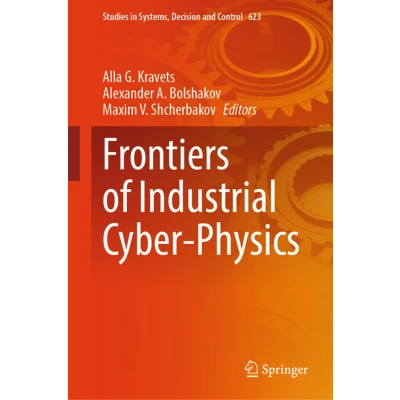
Frontiers of Industrial Cyber Physics: 623
Uitgelicht

|
155,00 |
Naar shop
|

|
158,60 |
Naar shop
|

|
158,60 |
Naar shop
|
 Beschrijving
Bol
This book represents a comprehensive exploration of the most recent advancements and applications at the intersection of machine learning, cyber-physical systems, and industrial processes. This book is divided into four primary sections, each focusing on distinct yet interconnected themes. The first section, ML-Based Industrial Solutions, highlights the transformative role of machine learning in industrial settings. Topics include the optimization of neural network architectures for atypical load forecasting in power grid cyber-physical systems, the use of vector autoregressive models for analyzing and forecasting consumption indicators, soft sensor-based fault detection and diagnosis in mass transfer processes, and the implementation of ML-based digital twins for predictive diagnostics in thermal power plants. Next, the book turns its attention to cyber-space for equipment reliability. Here, readers will find discussions on software tools for reliability analysis and efficiency assessment of technological equipment, methods for evaluating energy consumption, reliability estimations for automated lines with inter-operational storage devices, and the application of ANFIS network-based fuzzy expert systems for diagnosing power equipment defects. Additionally, this section includes considerations regarding the structure of knowledge models for solving control tasks in plants with parametric uncertainty. The third section, Unmanned Robotics, dives into the exciting world of autonomous systems. It covers topics such as modeling the optimal trajectory of reusable spacecraft entering the Earth's atmosphere, developing new methods for small unmanned helicopter emergency landings in case of onboard equipment failures, robust trajectory tracking control of nonholonomic wheeled mobile robots with external disturbances, and assessing the efficiency of passenger transportation in cyber-transport systems based on unmanned electric cars. Finally, the book concludes with a thorough examination of cybersecurity. The book is an essential resource for researchers, engineers, and professionals engaged in industrial automation, cyber-physical systems, and related disciplines. This book represents a comprehensive exploration of the most recent advancements and applications at the intersection of machine learning, cyber-physical systems, and industrial processes. This book is divided into four primary sections, each focusing on distinct yet interconnected themes. The first section, ML-Based Industrial Solutions, highlights the transformative role of machine learning in industrial settings. Topics include the optimization of neural network architectures for atypical load forecasting in power grid cyber-physical systems, the use of vector autoregressive models for analyzing and forecasting consumption indicators, soft sensor-based fault detection and diagnosis in mass transfer processes, and the implementation of ML-based digital twins for predictive diagnostics in thermal power plants. Next, the book turns its attention to cyber-space for equipment reliability. Here, readers will find discussions on software tools for reliability analysis and efficiency assessment of technological equipment, methods for evaluating energy consumption, reliability estimations for automated lines with inter-operational storage devices, and the application of ANFIS network-based fuzzy expert systems for diagnosing power equipment defects. Additionally, this section includes considerations regarding the structure of knowledge models for solving control tasks in plants with parametric uncertainty. The third section, Unmanned Robotics, dives into the exciting world of autonomous systems. It covers topics such as modeling the optimal trajectory of reusable spacecraft entering the Earth's atmosphere, developing new methods for small unmanned helicopter emergency landings in case of onboard equipment failures, robust trajectory tracking control of nonholonomic wheeled mobile robots with external disturbances, and assessing the efficiency of passenger transportation in cyber-transport systems based on unmanned electric cars. Finally, the book concludes with a thorough examination of cybersecurity. The book is an essential resource for researchers, engineers, and professionals engaged in industrial automation, cyber-physical systems, and related disciplines.


 Beschrijving
(1)
Beschrijving
(1)
This book represents a comprehensive exploration of the most recent advancements and applications at the intersection of machine learning, cyber-physical systems, and industrial processes. This book is divided into four primary sections, each focusing on distinct yet interconnected themes. The first section, ML-Based Industrial Solutions, highlights the transformative role of machine learning in industrial settings. Topics include the optimization of neural network architectures for atypical load forecasting in power grid cyber-physical systems, the use of vector autoregressive models for analyzing and forecasting consumption indicators, soft sensor-based fault detection and diagnosis in mass transfer processes, and the implementation of ML-based digital twins for predictive diagnostics in thermal power plants. Next, the book turns its attention to cyber-space for equipment reliability. Here, readers will find discussions on software tools for reliability analysis and efficiency assessment of technological equipment, methods for evaluating energy consumption, reliability estimations for automated lines with inter-operational storage devices, and the application of ANFIS network-based fuzzy expert systems for diagnosing power equipment defects. Additionally, this section includes considerations regarding the structure of knowledge models for solving control tasks in plants with parametric uncertainty. The third section, Unmanned Robotics, dives into the exciting world of autonomous systems. It covers topics such as modeling the optimal trajectory of reusable spacecraft entering the Earth's atmosphere, developing new methods for small unmanned helicopter emergency landings in case of onboard equipment failures, robust trajectory tracking control of nonholonomic wheeled mobile robots with external disturbances, and assessing the efficiency of passenger transportation in cyber-transport systems based on unmanned electric cars. Finally, the book concludes with a thorough examination of cybersecurity. The book is an essential resource for researchers, engineers, and professionals engaged in industrial automation, cyber-physical systems, and related disciplines. This book represents a comprehensive exploration of the most recent advancements and applications at the intersection of machine learning, cyber-physical systems, and industrial processes. This book is divided into four primary sections, each focusing on distinct yet interconnected themes. The first section, ML-Based Industrial Solutions, highlights the transformative role of machine learning in industrial settings. Topics include the optimization of neural network architectures for atypical load forecasting in power grid cyber-physical systems, the use of vector autoregressive models for analyzing and forecasting consumption indicators, soft sensor-based fault detection and diagnosis in mass transfer processes, and the implementation of ML-based digital twins for predictive diagnostics in thermal power plants. Next, the book turns its attention to cyber-space for equipment reliability. Here, readers will find discussions on software tools for reliability analysis and efficiency assessment of technological equipment, methods for evaluating energy consumption, reliability estimations for automated lines with inter-operational storage devices, and the application of ANFIS network-based fuzzy expert systems for diagnosing power equipment defects. Additionally, this section includes considerations regarding the structure of knowledge models for solving control tasks in plants with parametric uncertainty. The third section, Unmanned Robotics, dives into the exciting world of autonomous systems. It covers topics such as modeling the optimal trajectory of reusable spacecraft entering the Earth's atmosphere, developing new methods for small unmanned helicopter emergency landings in case of onboard equipment failures, robust trajectory tracking control of nonholonomic wheeled mobile robots with external disturbances, and assessing the efficiency of passenger transportation in cyber-transport systems based on unmanned electric cars. Finally, the book concludes with a thorough examination of cybersecurity. The book is an essential resource for researchers, engineers, and professionals engaged in industrial automation, cyber-physical systems, and related disciplines.
 Productspecificaties
 Prijshistorie
* Prijshistorie bevat geen data van Amazon, Amazon Marketplace.
Prijzen voor het laatst bijgewerkt op:
 Gerelateerde resultaten


