
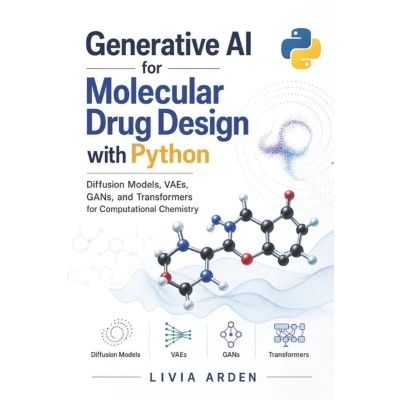
Generative AI for Molecular Drug Design with Python: Diffusion Models, VAEs, GANs, and Transformers Computational Chemistry
Uitgelicht

|
35,41 |
Naar shop
|

|
35,41 |
Naar shop
|

|
44,99 |
Naar shop
|
| VERGELIJK ALLE AANBIEDERS (3) | ||
 Beschrijving
Bol
Reactive PublishingArtificial intelligence is reshaping pharmaceutical research by enabling the computational generation of novel molecular structures. Generative AI for Molecular Drug Design with Python provides a technical, implementation-focused guide to building and evaluating generative models for small-molecule discovery.This book bridges machine learning engineering and computational chemistry. It explores how modern generative architectures can be applied to molecular representation, property prediction, and candidate generation using Python-based tooling.Topics include: - Molecular representations: SMILES, graphs, embeddings, and chemical descriptors- Variational Autoencoders (VAEs) for latent space exploration- Generative Adversarial Networks (GANs) for molecular synthesis- Diffusion models for structure generation and refinement- Transformer architectures applied to sequence-based chemical modeling- Dataset preparation, validation, and chemical constraint enforcement- Evaluating novelty, validity, and synthesizability- Integrating generative models into drug discovery workflowsPractical examples leverage PyTorch and common cheminformatics libraries to demonstrate end-to-end model development, from dataset preprocessing to molecular sampling and evaluation.Designed for quantitative researchers, ML engineers, computational chemists, and advanced students, this book focuses on implementation depth rather than high-level theory alone. Readers should have prior familiarity with Python and foundational machine learning concepts.The result is a rigorous, systems-level guide to applying generative AI in modern drug design pipelines.


 Beschrijving
(1)
Beschrijving
(1)
Reactive PublishingArtificial intelligence is reshaping pharmaceutical research by enabling the computational generation of novel molecular structures. Generative AI for Molecular Drug Design with Python provides a technical, implementation-focused guide to building and evaluating generative models for small-molecule discovery.This book bridges machine learning engineering and computational chemistry. It explores how modern generative architectures can be applied to molecular representation, property prediction, and candidate generation using Python-based tooling.Topics include: - Molecular representations: SMILES, graphs, embeddings, and chemical descriptors- Variational Autoencoders (VAEs) for latent space exploration- Generative Adversarial Networks (GANs) for molecular synthesis- Diffusion models for structure generation and refinement- Transformer architectures applied to sequence-based chemical modeling- Dataset preparation, validation, and chemical constraint enforcement- Evaluating novelty, validity, and synthesizability- Integrating generative models into drug discovery workflowsPractical examples leverage PyTorch and common cheminformatics libraries to demonstrate end-to-end model development, from dataset preprocessing to molecular sampling and evaluation.Designed for quantitative researchers, ML engineers, computational chemists, and advanced students, this book focuses on implementation depth rather than high-level theory alone. Readers should have prior familiarity with Python and foundational machine learning concepts.The result is a rigorous, systems-level guide to applying generative AI in modern drug design pipelines.
 Productspecificaties
 Prijshistorie
* Prijshistorie bevat geen data van Amazon, Amazon Marketplace.
Prijzen voor het laatst bijgewerkt op:
 Gerelateerde resultaten


