


€ 199,00 Gratis verzending

Uitgelicht
|
|
199,00 |
Naar shop
|

|
432,99 |
Naar shop
|
| VERGELIJK ALLE AANBIEDERS (2) | ||
 Beschrijving
Vergelijk aanbieders (2)
€ 199,00 Gratis verzending
€ 432,99 Gratis verzending
Winkels met andere maten
Beschrijving
(1)
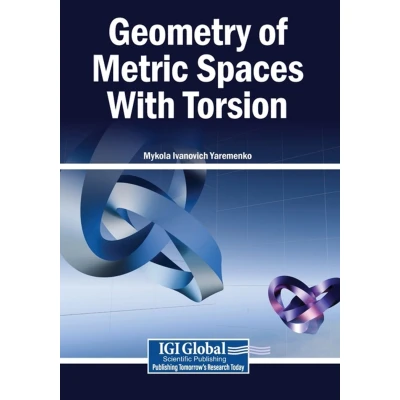
Space and time are not simple or directly observable quantities but concepts defined through measurement and physical processes, making their interpretation inherently complex. Their relationship forms a continuous spacetime framework in which observations depend on the motion of observers and the tools used to measure physical phenomena. Because measurement relies on physical systems influenced by forces like electromagnetism, scientific reasoning necessarily involves a degree of circularity that is intrinsic to how knowledge is constructed. To address this, physics translates observations into geometrical language, using mathematical structures such as metrics, connections, and tensors to describe how space, motion, and forces interact. Within this framework, efforts are made to unify gravity and electromagnetism by expressing them as properties of spacetime geometry, ultimately linking physical laws to the curvature and structure of the universe. Geometry of Metric Spaces With Torsion presents a theoretical framework that blends geometry, relativity, and quantum field theory to describe spacetime and fundamental physical interactions. It focuses on developing a unified model of electromagnetism and gravity using mathematical structures like metric and torsion tensors. Covering topics such as covariant derivative, metric tensor, and tensor densities, this book is an indispensable academic resource for graduate and doctoral students, theoretical physicists, mathematicians, faculty members, and more.
 Prijshistorie
 * Prijshistorie bevat geen data van Amazon.
Prijzen voor het laatst bijgewerkt op:
 Gerelateerde resultaten
 Productspecificaties


