
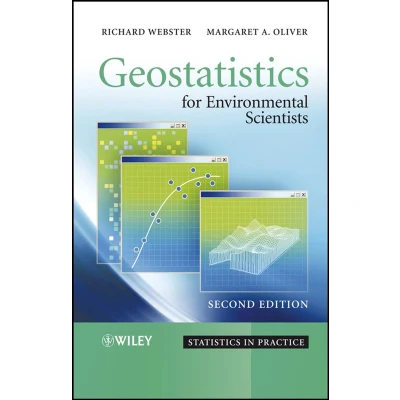
Geostatistics for Environmental Scientists
Uitgelicht

|
30,06 |
Naar shop
|

|
125,00 |
Naar shop
|
| VERGELIJK ALLE AANBIEDERS (2) | ||
 Beschrijving
Bol
There are many factors that environmental scientists should consider in their research. Weather and climate vary widely between locations, soil varies at every spatial scale at which it is examined, and even man-made attributes, such as the distribution of pollution, fluctuate significantly. There are many factors that environmental scientists should consider in their research. Weather and climate vary widely between locations, soil varies at every spatial scale at which it is examined, and even man-made attributes, such as the distribution of pollution, fluctuate significantly. To analyse the varied kinds of data and to predict at unvisited places from them, research scientists need to be familiar with the techniques of Geostatistics. This revised and fully updated second edition of Geostatistics for Environmental Scientists provides comprehensive coverage of the techniques involved in this vital branch of statistics. The book introduces readers to the most up-to-date statistical techniques, including, sampling, data screening, spatial covariances, the variogram and its modelling; includes a new chapter on stochastic simulation, and covers the latest methods, such as residual maximum likelihood and factorial kriging analysis; adopts a practical approach throughout, illustrating the applications with worked examples and case studies; provides step-by-step guidance for analysing environmental survey data; explains the underlying theory and rationale behind the choices faced by the researchers at each stage, allowing the reader to appreciate the assumptions and constraints involved. The accessible style of Geostatistics for Environmental Scientists, Second Edition makes this text invaluable to advanced undergraduate and graduate students of spatial variation and environmental research. Geostatistics is essential for environmental scientists. Weather and climate vary from place to place, soil varies at every scale at which it is examined, and even man-made attributes – such as the distribution of pollution – vary. The techniques used in geostatistics are ideally suited to the needs of environmental scientists, who use them to make the best of sparse data for prediction, and top plan future surveys when resources are limited. Geostatistical technology has advanced much in the last few years and many of these developments are being incorporated into the practitioner’s repertoire. This second edition describes these techniques for environmental scientists. Topics such as stochastic simulation, sampling, data screening, spatial covariances, the variogram and its modeling, and spatial prediction by kriging are described in rich detail. At each stage the underlying theory is fully explained, and the rationale behind the choices given, allowing the reader to appreciate the assumptions and constraints involved.


 Beschrijving
(2)
Beschrijving
(2)
There are many factors that environmental scientists should consider in their research. Weather and climate vary widely between locations, soil varies at every spatial scale at which it is examined, and even man-made attributes, such as the distribution of pollution, fluctuate significantly. There are many factors that environmental scientists should consider in their research. Weather and climate vary widely between locations, soil varies at every spatial scale at which it is examined, and even man-made attributes, such as the distribution of pollution, fluctuate significantly. To analyse the varied kinds of data and to predict at unvisited places from them, research scientists need to be familiar with the techniques of Geostatistics. This revised and fully updated second edition of Geostatistics for Environmental Scientists provides comprehensive coverage of the techniques involved in this vital branch of statistics. The book introduces readers to the most up-to-date statistical techniques, including, sampling, data screening, spatial covariances, the variogram and its modelling; includes a new chapter on stochastic simulation, and covers the latest methods, such as residual maximum likelihood and factorial kriging analysis; adopts a practical approach throughout, illustrating the applications with worked examples and case studies; provides step-by-step guidance for analysing environmental survey data; explains the underlying theory and rationale behind the choices faced by the researchers at each stage, allowing the reader to appreciate the assumptions and constraints involved. The accessible style of Geostatistics for Environmental Scientists, Second Edition makes this text invaluable to advanced undergraduate and graduate students of spatial variation and environmental research. Geostatistics is essential for environmental scientists. Weather and climate vary from place to place, soil varies at every scale at which it is examined, and even man-made attributes – such as the distribution of pollution – vary. The techniques used in geostatistics are ideally suited to the needs of environmental scientists, who use them to make the best of sparse data for prediction, and top plan future surveys when resources are limited. Geostatistical technology has advanced much in the last few years and many of these developments are being incorporated into the practitioner’s repertoire. This second edition describes these techniques for environmental scientists. Topics such as stochastic simulation, sampling, data screening, spatial covariances, the variogram and its modeling, and spatial prediction by kriging are described in rich detail. At each stage the underlying theory is fully explained, and the rationale behind the choices given, allowing the reader to appreciate the assumptions and constraints involved.
Bol PartnerGeostatistics is essential for modern environmental scientists. Weather and climate vary from place to place, soil varies at every scale at which it is examined, and even man-made attributes - such as the distribution of pollution - vary. The techniques used in geostatistics are ideally suited to the needs of environmental scientists, who use them to make the best of sparse data for prediction, and to plan future surveys when resources are limited.* Concise but comprehensive introduction to the latest statistical techniques* Strong emphasis on practical applications throughout* Illustrated with worked examples from soil surveys* Coverage of more advanced topics, such as multivariate analysis* Contains a step-by-step summary of the procedure needed to analyse survey dataSampling, data screening, spatial covariances, the variogram and its modelling, and spatial prediction by kriging are described in rich detail. At each stage the underlying theory is fully explained, and the rationale behind the choices given, allowing the reader to appreciate the assumptions and constraints involved.Environmental scentists will find this text an invaluable guide to geostatistics, and the lucid style will suit the needs of advanced undergraduates and graduate students of spatial variation and environmental science.
 Productspecificaties
| EAN |
|
|---|---|
| Maat |
|
 Prijshistorie
Prijzen voor het laatst bijgewerkt op:
 Gerelateerde resultaten


