
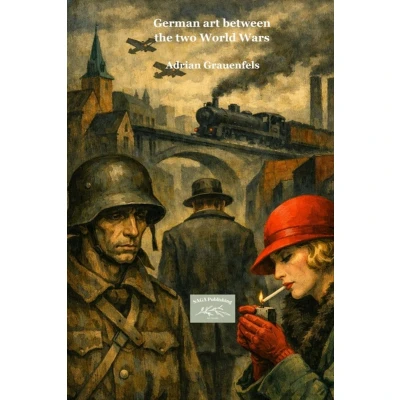
German art between the two World Wars
Uitgelicht

|
21,00 |
Naar shop
|

|
23,22 |
Naar shop
|

|
23,22 |
Naar shop
|
| VERGELIJK ALLE AANBIEDERS (3) | ||
 Beschrijving
Bol
The arts held a prominent place in the years following the First World War. Until the late 19th century, German art had been dominated by neoclassical forms. The passionate descriptions of nature from Romanticism were also present on the German art scene, yet the direct or composite classical style remained the most widespread form. Music and dance were similarly classical and formal. This began to change at the turn of the century, when German artists began splintering into experimental groups and developed German Expressionism. German art as a whole would never be the same again; artists across every discipline began to push back against the constraints of classical schools and started using their arts to defy tradition and the social order. Visual art in Germany flourished particularly between 1900 and 1933. German Expressionism emphasized the artists' emotions and rejected realism in favor of semi-abstraction, sharp angles, and intense colors, as well as the use of traditional mediums in novel ways. This shift was inspired by a desire to bridge the past and the present in a new art form. In their manifesto, The Bridge (Die Brücke), one of the first German Expressionist collectives, declared that through their art, "we call all young people together, and as young people, who carry the future within us, we want to wrest freedom for our actions and our lives from the older, comfortably established forces."


 Beschrijving
(1)
Beschrijving
(1)
The arts held a prominent place in the years following the First World War. Until the late 19th century, German art had been dominated by neoclassical forms. The passionate descriptions of nature from Romanticism were also present on the German art scene, yet the direct or composite classical style remained the most widespread form. Music and dance were similarly classical and formal. This began to change at the turn of the century, when German artists began splintering into experimental groups and developed German Expressionism. German art as a whole would never be the same again; artists across every discipline began to push back against the constraints of classical schools and started using their arts to defy tradition and the social order. Visual art in Germany flourished particularly between 1900 and 1933. German Expressionism emphasized the artists' emotions and rejected realism in favor of semi-abstraction, sharp angles, and intense colors, as well as the use of traditional mediums in novel ways. This shift was inspired by a desire to bridge the past and the present in a new art form. In their manifesto, The Bridge (Die Brücke), one of the first German Expressionist collectives, declared that through their art, "we call all young people together, and as young people, who carry the future within us, we want to wrest freedom for our actions and our lives from the older, comfortably established forces."
 Productspecificaties
 Prijshistorie
* Prijshistorie bevat geen data van Amazon, Amazon Marketplace.
Prijzen voor het laatst bijgewerkt op:
 Gerelateerde resultaten


