








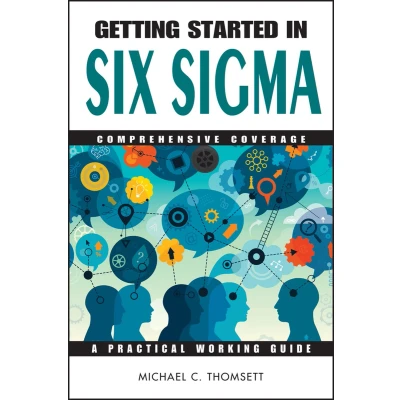
Getting Started in Six Sigma
Uitgelicht

|
23,99
20,00 |
Naar shop
|
 Beschrijving
Bol
The basics behind the Six Sigma quality control technique Six Sigma is designed to achieve excellence in customer service and measure deviation from the ideal. It provides a process for placing value on the intangible nature of quality control. The underlying theories of Six Sigma are highly technical and complex. A STEP-BY-STEP GUIDE TO GETTING STARTED IN SIX SIGMA Six Sigma in many organizations simply means defining and measuring quality; a working system designed to identify that elusive goal, perfection. Companies such as GE, Microsoft, and 3M have used this approach to eliminate product defects, reduce cycle time, and improve customer satisfaction. Six Sigma may sound intimidating, but the fact is that you don't have to be a high-level executive at a giant corporation to useor understandthis concept. It is simply a way of improving quality. Getting Started in Six Sigma is designed to show you, step by step, how Six Sigma works and how it can be used most effectively. Whether you're a manager trying to change your approach to problem solving or an employee in a corporation with a Six Sigma program, this book will clearly lead you through each step of the process. Definitions within the marginsplaced at points of discussionwill help you to quickly master Six Sigma terminology as you read along. In a straightforward and accessible style, Getting Started in Six Sigma will familiarize you with: The real meaning of Six Sigmatechnical and philosophical The importance of both internal and external customers DMAIC (Define, Measure, Analyze, Improve, Control)the tactical approach to Six Sigma projects Product and service defects and how to reduce them Effectively improving process systems Striving for consistency Filled with numerous examples, checklists, and graphics, Getting Started in Six Sigma will help you gain a firm understanding of the topic and illustrate how this idea can make any organization function better. The basics behind the Six Sigma quality control technique Six Sigma is designed to achieve excellence in customer service and measure deviation from the ideal. It provides a process for placing value on the intangible nature of quality control. The underlying theories of Six Sigma are highly technical and complex. This book is a basic guide to those who are new to the concept, and though this is a complex subject, the concepts involved are not too complex for readers to grasp. Getting Started in Six Sigma demonstrates how an employee or supervisor can implement Six Sigma successfully without having to become technically familiar with process-oriented models or statistical modeling.


Vergelijk aanbieders (1)

 Beschrijving
(1)
Beschrijving
(1)
The basics behind the Six Sigma quality control technique Six Sigma is designed to achieve excellence in customer service and measure deviation from the ideal. It provides a process for placing value on the intangible nature of quality control. The underlying theories of Six Sigma are highly technical and complex. A STEP-BY-STEP GUIDE TO GETTING STARTED IN SIX SIGMA Six Sigma in many organizations simply means defining and measuring quality; a working system designed to identify that elusive goal, perfection. Companies such as GE, Microsoft, and 3M have used this approach to eliminate product defects, reduce cycle time, and improve customer satisfaction. Six Sigma may sound intimidating, but the fact is that you don't have to be a high-level executive at a giant corporation to useor understandthis concept. It is simply a way of improving quality. Getting Started in Six Sigma is designed to show you, step by step, how Six Sigma works and how it can be used most effectively. Whether you're a manager trying to change your approach to problem solving or an employee in a corporation with a Six Sigma program, this book will clearly lead you through each step of the process. Definitions within the marginsplaced at points of discussionwill help you to quickly master Six Sigma terminology as you read along. In a straightforward and accessible style, Getting Started in Six Sigma will familiarize you with: The real meaning of Six Sigmatechnical and philosophical The importance of both internal and external customers DMAIC (Define, Measure, Analyze, Improve, Control)the tactical approach to Six Sigma projects Product and service defects and how to reduce them Effectively improving process systems Striving for consistency Filled with numerous examples, checklists, and graphics, Getting Started in Six Sigma will help you gain a firm understanding of the topic and illustrate how this idea can make any organization function better. The basics behind the Six Sigma quality control technique Six Sigma is designed to achieve excellence in customer service and measure deviation from the ideal. It provides a process for placing value on the intangible nature of quality control. The underlying theories of Six Sigma are highly technical and complex. This book is a basic guide to those who are new to the concept, and though this is a complex subject, the concepts involved are not too complex for readers to grasp. Getting Started in Six Sigma demonstrates how an employee or supervisor can implement Six Sigma successfully without having to become technically familiar with process-oriented models or statistical modeling.
 Productspecificaties
| EAN |
|
|---|---|
| Maat |
|
 Prijshistorie
Prijzen voor het laatst bijgewerkt op:
 Gerelateerde resultaten


