


€ 124,06 Gratis verzending

Uitgelicht
|
|
124,06 |
Naar shop
|

|
194,99 |
Naar shop
|
| VERGELIJK ALLE AANBIEDERS (2) | ||
 Beschrijving
Vergelijk aanbieders (2)
€ 124,06 Gratis verzending
€ 194,99 Gratis verzending
Winkels met andere maten
Beschrijving
(1)
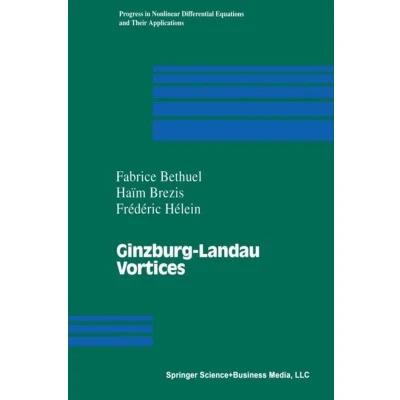
The mathematics in this book apply directly to classical problems in superconductors, superfluids and liquid crystals. It should be of interest to mathematicians, physicists and engineers working on modern materials research. The original motivation of this study comes from the following questions that were mentioned to one ofus by H. Matano. Let 2 2 G= B = {x=(X1lX2) E 2; x~ + x~ = Ixl < 1}. 1 Consider the Ginzburg-Landau functional 2 2 (1) E~(u) = ~ LIVul + 4~2 L(lu1 _1)2 which is defined for maps u E H1(G;C) also identified with Hl(G;R2). Fix the boundary condition 9(X) =X on 8G and set H; = {u E H1(G;C); u = 9 on 8G}. It is easy to see that (2) is achieved by some u~ that is smooth and satisfies the Euler equation in G, -~u~ = :2 u~(1 _lu~12) (3) { on aGo u~ =9 Themaximum principleeasily implies (see e.g., F. Bethuel, H. Brezisand F. Helein (2]) that any solution u~ of (3) satisfies lu~1 ~ 1 in G. In particular, a subsequence (u~,.) converges in the w* - LOO(G) topology to a limit u*.
 Productspecificaties
| EAN |
|
|---|---|
| Maat |
|
 Prijshistorie
Prijzen voor het laatst bijgewerkt op:
 Gerelateerde resultaten


