


€ 168,20 Gratis verzending

Uitgelicht
|
|
168,20 |
Naar shop
|
| VERGELIJK ALLE AANBIEDERS (1) | ||
 Beschrijving
Vergelijk aanbieders (1)
€ 168,20 Gratis verzending
Winkels met andere maten
Beschrijving
(1)
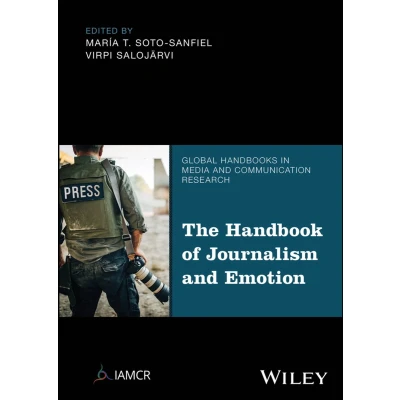
Understanding journalism through the lens of emotion: a global and interdisciplinary perspective The Handbook of Journalism and Emotion is the first comprehensive collection to explore the central role of emotion in shaping journalism across the globe. Featuring contributions from 60 leading scholars across five continents, this landmark volume investigates how emotion influences journalism's theoretical foundations, production processes, content creation, and audience reception. As the field undergoes an "emotional turn," the authors provide cortical insights into the evolving nature of journalism in a world increasingly defined by affective engagement. Organized into four thematic sections—Theory, Production, Content, and Responses—the Handbook presents a wide range of interdisciplinary research drawing from communication, psychology, sociology, linguistics, and neuroscience. Topics range from emotional labor and trauma in reporting to the use of emotion in narrative structure, ethical journalism, and audience reactions. Through diverse methodologies and cultural lenses, in-depth chapters reveal how emotion intersects with journalism at every level, highlighting its influence on media systems, professional identity, and public discourse. The Handbook of Journalism and Emotion: Theory, Production, Content and Responses is an essential reference for researchers, graduate students, and upper-level undergraduates in journalism, media studies, and communication. It will also benefit media educators, journalists, editors, and professionals working in emotionally demanding environments or seeking to better understand how emotion shapes news production and consumption. A groundbreaking global exploration of how emotions shape journalism Emotion is no longer peripheral to journalism—it is central to how news is made, shared, and experienced. The Handbook of Journalism and Emotions: Theory, Production, Content and Responses redefines how we understand journalism in today’s emotionally charged world, bringing together 60 leading scholars from across five continents to investigate how emotion shapes journalism theory, production practices, content, and audience engagement. Organized into four thematic sections—Theory, Production, Content, and Responses—the Handbook covers topics ranging from emotional labor and trauma in reporting to audience reactions and emotional authority in visual storytelling. Drawing from sociology, psychology, communication, linguistics, and neuroscience, in-depth chapters highlight how emotional forces interact with journalistic values, ethics, and norms. Throughout the book, in-depth chapters respond to the growing scholarly and professional recognition of the “emotional turn” in media studies, filling a critical gap in media and communication scholarship. The first book to provide an interdisciplinary, multicultural, and methodologically diverse analysis of the pivotal role of emotion across all dimensions of journalism, the Handbook of Journalism and Emotions: Presents cutting-edge research that integrates communication studies, sociology, psychology, neuroscience, and media theory Employs a wide range of methods, including digital ethnography, content analysis, interviews, experiments, and meta-analysis Covers both traditional and digital media formats, such as audio-visual journalism, social media, and multimodal storytelling Engages with timely global issues, such as conflict reporting, populism, misinformation, and journalistic safety Situates emotion as an essential aspect of journalism’s epistemology, examining its role in both individual and collective experience Highlights under-researched perspectives from Latin America, Sub-Saharan Africa, Southeast Asia, and other regions worldwide Ideal for scholars, students, and professionals, the Handbook of Journalism and Emotions: Theory, Production, Content and Responses is a core reference for courses in journalism, communication, media and cultural studies, and emotion research. It is also a key resource for journalists, editors, media educators, and policymakers seeking to understand and teach the emotional complexities of modern journalism.
 Productspecificaties
| EAN |
|
|---|---|
| Maat |
|
 Prijshistorie
Prijzen voor het laatst bijgewerkt op:
 Gerelateerde resultaten


