








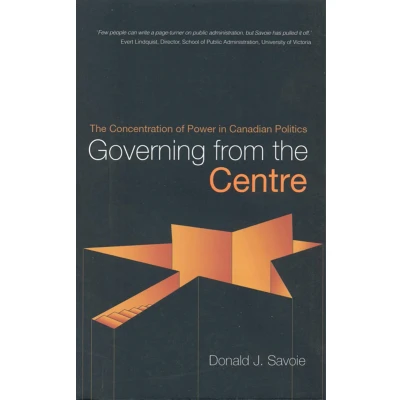
Governing from the Centre
Uitgelicht

|
24,64 |
Naar shop
|

|
174,00 |
Naar shop
|
 Beschrijving
Bol Partner
Agencies and policies instituted to streamline Ottawa's planning process instead concentrate power in the hands of the Prime Minister, more powerful in Canadian politics than the U.S. President in America. Riveting, startling, and indispensable reading. Redefined during the past thirty years, the centre of government currently extends itself further than ever before. Central governmental agencies are 'where the rubber meets the road', where public service meets politics, and policy becomes reality. So who's driving this car? Agencies such as the Privy Council Office, the Finance Department, and the Treasury Board exert their influence horizontally, deciding how policy is made and how money gets spent According to Donald Savoie, these organizations, instituted to streamline Ottawa's planning processes, instead telescope power to the Prime Minister and weaken the influence of ministers, the traditional line departments, and even parliament, without contributing to more rational and coherent policy-making. This is scholarship at its best: rigorous and riveting. The government operates as a combination of known procedures and the more elusive subtleties of human relationships and unspoken codes of behaviour. Donald Savoie's long-time involvement in government affairs allows him to read through the surface of the results of his extensive research-which included several interviews with elites-in order to expose all the levels of power at play. Indispensable reading for students of politics, public policy, and public administration, Ottawa watchers, journalists, lobbyists, and civil servants who want to know what is really going on.


 Beschrijving
(2)
Beschrijving
(2)
Agencies and policies instituted to streamline Ottawa's planning process instead concentrate power in the hands of the Prime Minister, more powerful in Canadian politics than the U.S. President in America. Riveting, startling, and indispensable reading. Redefined during the past thirty years, the centre of government currently extends itself further than ever before. Central governmental agencies are 'where the rubber meets the road', where public service meets politics, and policy becomes reality. So who's driving this car? Agencies such as the Privy Council Office, the Finance Department, and the Treasury Board exert their influence horizontally, deciding how policy is made and how money gets spent According to Donald Savoie, these organizations, instituted to streamline Ottawa's planning processes, instead telescope power to the Prime Minister and weaken the influence of ministers, the traditional line departments, and even parliament, without contributing to more rational and coherent policy-making. This is scholarship at its best: rigorous and riveting. The government operates as a combination of known procedures and the more elusive subtleties of human relationships and unspoken codes of behaviour. Donald Savoie's long-time involvement in government affairs allows him to read through the surface of the results of his extensive research-which included several interviews with elites-in order to expose all the levels of power at play. Indispensable reading for students of politics, public policy, and public administration, Ottawa watchers, journalists, lobbyists, and civil servants who want to know what is really going on.
BolTwo leading authors challenge the assumption that France has a well-coordinated government. The constitutional, political,and policy frameworks of coordination are critically assessed in relation to the central actors and the spending ministries, as well as the formal and informal mechanisms of coordination. Two leading authors challenge the assumption that France has a well coordinated government. The constitutional, political,and policy frameworks of coordination are critically assessed in relation to the central actors and spending ministries, as well as the formal and informal mechanisms of coordination. Four case studies are examined; the European Union, budget, privatization and immigration policy processes. The book concludes with forthright findings on a fragment executive struggling to steer a disparate and partially paralyzed institutional structure. The research findings offer precise cautionary recommendations to policy makers against the dangers of overconfident recourse to 'joined up' government. The findings are relevant, not merely to France, but generally to Western states more generally.
 Productspecificaties
| EAN |
|
|---|---|
| Maat |
|
 Prijshistorie
Prijzen voor het laatst bijgewerkt op:
 Gerelateerde resultaten


