
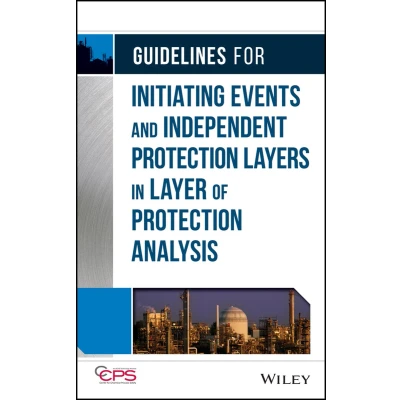
Guidelines for Initiating Events and Independent Protection Layers in Layer of Analysis
Uitgelicht

|
113,26
91,50 |
Naar shop
|
| VERGELIJK ALLE AANBIEDERS (1) | ||
 Beschrijving
Bol
The publication provides process automation engineers, process engineers, facility operators, and safety professionals with the appropriate treatment and requirements applicable to equipment design, administrative procedures, or other credits that are treated as an independent protection layer from a Layer of Protection Analysis (LOPA) perspective. The book is a guide for Layers of Protection Analysis (LOPA) practitioners. It explains the onion skin model and in particular, how it relates to the use of LOPA and the need for non-safety instrumented independent protection layers. It provides specific guidance on Independent Protection Layers (IPLs) that are not Safety Instrumented Systems (SIS). Using the LOPA methodology, companies typically take credit for risk reductions accomplished through non-SIS alternatives; i.e. administrative procedures, equipment design, etc. It addresses issues such as how to ensure the effectiveness and maintain reliability for administrative controls or “inherently safer, passive” concepts. This book will address how the fields of Human Reliability Analysis, Fault Tree Analysis, Inherent Safety, Audits and Assessments, Maintenance, and Emergency Response relate to LOPA and SIS. The book will separate IPL’s into categories such as the following: Inherent Safety eliminates a scenario or fundamentally reduces a hazard Preventive/Proactive prevents initiating event from occurring such as enhanced maintenance Preventive/Active stops chain of events after initiating event occurs but before an incident has occurred such as high level in a tank shutting off the pump. Mitigation (active or passive) minimizes impact once an incident has occurred such as closing block valves once LEL is detected in the dike (active) or the dike preventing contamination of groundwater (passive).


Vergelijk aanbieders (1)

 Beschrijving
(1)
Beschrijving
(1)
The publication provides process automation engineers, process engineers, facility operators, and safety professionals with the appropriate treatment and requirements applicable to equipment design, administrative procedures, or other credits that are treated as an independent protection layer from a Layer of Protection Analysis (LOPA) perspective. The book is a guide for Layers of Protection Analysis (LOPA) practitioners. It explains the onion skin model and in particular, how it relates to the use of LOPA and the need for non-safety instrumented independent protection layers. It provides specific guidance on Independent Protection Layers (IPLs) that are not Safety Instrumented Systems (SIS). Using the LOPA methodology, companies typically take credit for risk reductions accomplished through non-SIS alternatives; i.e. administrative procedures, equipment design, etc. It addresses issues such as how to ensure the effectiveness and maintain reliability for administrative controls or “inherently safer, passive” concepts. This book will address how the fields of Human Reliability Analysis, Fault Tree Analysis, Inherent Safety, Audits and Assessments, Maintenance, and Emergency Response relate to LOPA and SIS. The book will separate IPL’s into categories such as the following: Inherent Safety eliminates a scenario or fundamentally reduces a hazard Preventive/Proactive prevents initiating event from occurring such as enhanced maintenance Preventive/Active stops chain of events after initiating event occurs but before an incident has occurred such as high level in a tank shutting off the pump. Mitigation (active or passive) minimizes impact once an incident has occurred such as closing block valves once LEL is detected in the dike (active) or the dike preventing contamination of groundwater (passive).
 Productspecificaties
| EAN |
|
|---|---|
| Maat |
|
 Prijshistorie
Prijzen voor het laatst bijgewerkt op:
 Gerelateerde resultaten


