
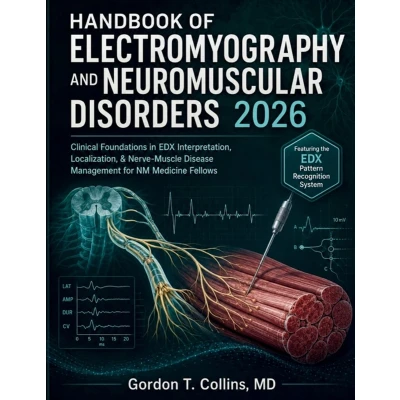
Handbook of Electromyography and Neuromuscular Disorders 2026: Clinical Foundations in EDX Interpretation, Localization, & Nerve-Muscle Disease Management for NM Medicine Fellows
Uitgelicht

|
137,71 |
Naar shop
|

|
139,01 |
Naar shop
|

|
139,01 |
Naar shop
|
| VERGELIJK ALLE AANBIEDERS (3) | ||
 Beschrijving
Bol
The patient in Bay 4 has footdrop, a normal MRI, and a neurologist who needs an answer before the team rounds in forty minutes. Most EDX references were written for the study room, not the laboratory bench - and the gap between knowing the physiology and reading the tracing in real time is exactly where diagnostic errors are made and patients are misclassified. This handbook closes that gap, delivering a complete electrodiagnostic reasoning framework built for the clinician performing and interpreting studies under time pressure, with the EDX Pattern Recognition System embedded in every chapter to name the pattern, anchor the decision, and flag the traps before they cost the patient. - The preganglionic switch - determine in seconds whether the spine or the peripheral nerve is the source of any sensory deficit, using SNAP amplitude as the single first-order localization tool - The branching sequence rule - bracket any nerve lesion between its most proximal abnormal and most distal normal muscle to achieve millimeter-level localization without ambiguity - The five-mimic exclusion protocol - systematically exclude MMN, Kennedy disease, IBM, Hirayama disease, and cervical myeloradiculopathy before delivering an ALS diagnosis - The paraspinal myotonic discharge rule - recognize Pompe disease in adults before years of failed immunotherapy accumulate - The amplitude-velocity proportionality test - stop misclassifying severe axonal polyneuropathy as CIDP and sending patients to unnecessary IVIG - The MUAP uniformity test - distinguish treatable inflammatory myopathy from treatment-resistant IBM at the needle, before biopsy >Written for neuromuscular medicine fellows, neurology and PM&R residents, clinical neurophysiology trainees, and any physician who performs or interprets electrodiagnostic studies in clinical practice.


 Beschrijving
(1)
Beschrijving
(1)
The patient in Bay 4 has footdrop, a normal MRI, and a neurologist who needs an answer before the team rounds in forty minutes. Most EDX references were written for the study room, not the laboratory bench - and the gap between knowing the physiology and reading the tracing in real time is exactly where diagnostic errors are made and patients are misclassified. This handbook closes that gap, delivering a complete electrodiagnostic reasoning framework built for the clinician performing and interpreting studies under time pressure, with the EDX Pattern Recognition System embedded in every chapter to name the pattern, anchor the decision, and flag the traps before they cost the patient. - The preganglionic switch - determine in seconds whether the spine or the peripheral nerve is the source of any sensory deficit, using SNAP amplitude as the single first-order localization tool - The branching sequence rule - bracket any nerve lesion between its most proximal abnormal and most distal normal muscle to achieve millimeter-level localization without ambiguity - The five-mimic exclusion protocol - systematically exclude MMN, Kennedy disease, IBM, Hirayama disease, and cervical myeloradiculopathy before delivering an ALS diagnosis - The paraspinal myotonic discharge rule - recognize Pompe disease in adults before years of failed immunotherapy accumulate - The amplitude-velocity proportionality test - stop misclassifying severe axonal polyneuropathy as CIDP and sending patients to unnecessary IVIG - The MUAP uniformity test - distinguish treatable inflammatory myopathy from treatment-resistant IBM at the needle, before biopsy >Written for neuromuscular medicine fellows, neurology and PM&R residents, clinical neurophysiology trainees, and any physician who performs or interprets electrodiagnostic studies in clinical practice.
 Productspecificaties
 Prijshistorie
* Prijshistorie bevat geen data van Amazon, Amazon Marketplace.
Prijzen voor het laatst bijgewerkt op:
 Gerelateerde resultaten


