


€ 129,00 Gratis verzending

Uitgelicht
|
|
129,00 |
Naar shop
|

|
137,73 |
Naar shop
|

|
137,73 |
Naar shop
|
| VERGELIJK ALLE AANBIEDERS (3) | ||
 Beschrijving
Vergelijk aanbieders (3)
€ 129,00 Gratis verzending
€ 137,73 Gratis verzending
€ 137,73 Gratis verzending
Winkels met andere maten
Beschrijving
(1)
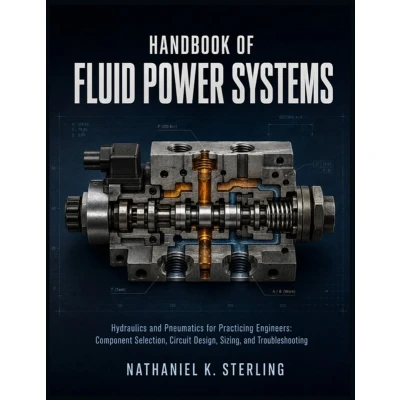
A hydraulic press slows in mid-cycle. The pump is replaced, then the relief valve, then the seals - and the press still crawls, because the component that was changed was never the one that failed. The introductory course does not prepare an engineer for this. A single semester derives Pascal's principle, sizes a cylinder, draws a relief valve, and moves on. The engineer then made responsible for real equipment finds the drawing carries twenty symbols that were never taught, and a valve data sheet quoting flow at a pressure drop that does not match the application. Knowing what a relief valve does is a different thing from being able to size one. This handbook was written for that gap. It assumes a reader competent in engineering fundamentals who is now accountable for equipment that has to work, and treats fluid power as a connected body of method running from the physics of the fluid to the behaviour of a real machine. Hydraulics and pneumatics are covered together, because the practitioner meets them together and compressibility is clearest by direct comparison. What this handbook gives you - Derivations that show their origins, so every working figure carries the conditions that limit it and you can see when the customary answer stops being right- Sizing methods you can apply directly - conductors on velocity and loss, pumps and prime movers from a duty cycle, actuators, directional valves, filtration, accumulators, and cooling from thermal load rather than habit- Unit discipline carried through every step, in SI with United States customary values alongside, addressing the conversion and gauge-versus-absolute errors that reach commissioning more often than conceptual ones- Component behaviour described both as designed and as degraded, so a worn pump can be distinguished from a starved one- A diagnostic method reasoning backwards from symptom to cause, with troubleshooting matrices naming the measurement that confirms or eliminates each candidate- Electrohydraulic motion control as a full subject, with the dynamic analysis closed-loop systems require- Energy accounting that locates where input power actually goes, and the architectures that avoid turning it into heat Coverage >Sixteen chapters and five appendices. One hundred and twenty-nine worked examples with every step and unit shown. One hundred and sixty practice problems with worked answers. Fifty original figures, circuit diagrams following the internationally standardised symbol conventions, conversion tables, fluid property data, sizing formulas, and troubleshooting matrices. Who it is for >Open the handbook and begin working from measurement rather than replacement - through the principles, the components, the circuits, and the method that connects them
 Prijshistorie
* Prijshistorie bevat geen data van Amazon, Amazon Marketplace.
Prijzen voor het laatst bijgewerkt op:
 Gerelateerde resultaten
 Productspecificaties


