
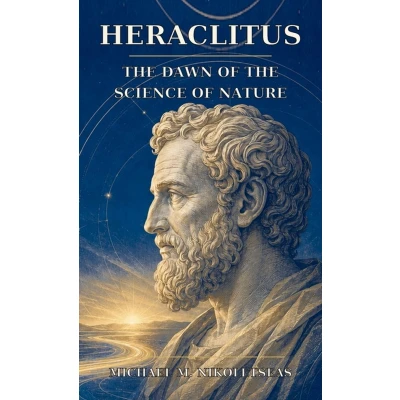
Heraclitus: the Dawn of Science Nature
Uitgelicht

|
33,99 |
Naar shop
|
| VERGELIJK ALLE AANBIEDERS (1) | ||
 Beschrijving
Bol
For more than twenty-five centuries, Heraclitus has been presented as the philosopher of universal flux: the obscure thinker who declared that everything changes, that conflict governs the world, and that opposites are ultimately one. Heraclitus: The Dawn of the Science of Nature challenges this inherited interpretation at its foundation.At the center of Heraclitus' thought, Michael M. Nikoletseas identifies a radical critique of natural language. Ordinary speech divides the world into fixed names, separate objects, and opposing categories. It mistakes the appearances delivered by the senses for the structure of nature itself. Heraclitus recognized that a changing world cannot be adequately understood through a language that merely names its successive states.His images of the river, fire, the bow and lyre, the road, the circle, and the measured course of the sun are therefore not disconnected metaphysical sayings. They direct thought beyond visible change toward measure, proportion, recurrence, constraint, and law. Flux belongs to appearances; permanence belongs to the relations that make change intelligible.The book reconstructs logos as both the common order of nature and the disciplined mode of thought required to represent it. What remains constant is not an immovable substance hidden behind the world, but lawful relation within transformation. Waters pass while the river retains its structure. Fire kindles and is extinguished according to measure. Contrary movements remain joined within a functioning whole.This interpretation also transforms the traditional relationship between Heraclitus and Parmenides. Rather than representing opposing doctrines of becoming and Being, Parmenides emerges as the first great receiver of the Heraclitean project. His eon gives poetic form to the demand for unity, continuity, coherence, necessity, and limit.Drawing upon the complete surviving Heraclitean corpus and engaging the long history of interpretation from Plato and Aristotle to modern scholarship, the book explains how Heraclitus became the philosopher of flux and how the original problem of representation disappeared beneath later philosophical categories.Heraclitus did not possess mathematical physics or controlled experimentation. His achievement was more fundamental: he recognized that nature cannot be understood through ordinary language alone. Science begins when changing appearances are represented through common relations and laws that do not change in the same way. In this precise sense, Heraclitus stands at the dawn of the science of nature.


Vergelijk aanbieders (1)

 Beschrijving
(1)
Beschrijving
(1)
For more than twenty-five centuries, Heraclitus has been presented as the philosopher of universal flux: the obscure thinker who declared that everything changes, that conflict governs the world, and that opposites are ultimately one. Heraclitus: The Dawn of the Science of Nature challenges this inherited interpretation at its foundation.At the center of Heraclitus' thought, Michael M. Nikoletseas identifies a radical critique of natural language. Ordinary speech divides the world into fixed names, separate objects, and opposing categories. It mistakes the appearances delivered by the senses for the structure of nature itself. Heraclitus recognized that a changing world cannot be adequately understood through a language that merely names its successive states.His images of the river, fire, the bow and lyre, the road, the circle, and the measured course of the sun are therefore not disconnected metaphysical sayings. They direct thought beyond visible change toward measure, proportion, recurrence, constraint, and law. Flux belongs to appearances; permanence belongs to the relations that make change intelligible.The book reconstructs logos as both the common order of nature and the disciplined mode of thought required to represent it. What remains constant is not an immovable substance hidden behind the world, but lawful relation within transformation. Waters pass while the river retains its structure. Fire kindles and is extinguished according to measure. Contrary movements remain joined within a functioning whole.This interpretation also transforms the traditional relationship between Heraclitus and Parmenides. Rather than representing opposing doctrines of becoming and Being, Parmenides emerges as the first great receiver of the Heraclitean project. His eon gives poetic form to the demand for unity, continuity, coherence, necessity, and limit.Drawing upon the complete surviving Heraclitean corpus and engaging the long history of interpretation from Plato and Aristotle to modern scholarship, the book explains how Heraclitus became the philosopher of flux and how the original problem of representation disappeared beneath later philosophical categories.Heraclitus did not possess mathematical physics or controlled experimentation. His achievement was more fundamental: he recognized that nature cannot be understood through ordinary language alone. Science begins when changing appearances are represented through common relations and laws that do not change in the same way. In this precise sense, Heraclitus stands at the dawn of the science of nature.
 Productspecificaties
| EAN |
|
|---|---|
| Maat |
|
 Prijshistorie
Prijzen voor het laatst bijgewerkt op:
 Gerelateerde resultaten


