








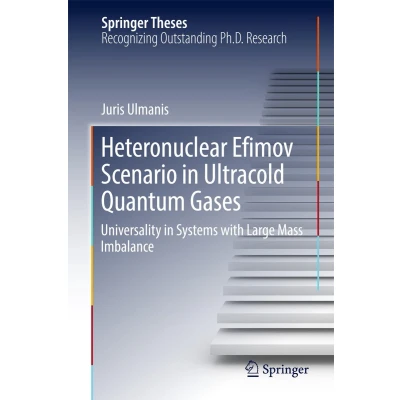
Heteronuclear Efimov Scenario in Ultracold Quantum Gases
Uitgelicht

|
51,99 |
Naar shop
|
 Beschrijving
Bol
This thesis represents a decisive breakthrough in our understanding of the physics of universal quantum-mechanical three-body systems. The Efimov scenario is a prime example of how fundamental few-body physics features universally across seemingly disparate fields of modern quantum physics. This thesis represents a decisive breakthrough in our understanding of the physics of universal quantum-mechanical three-body systems. The Efimov scenario is a prime example of how fundamental few-body physics features universally across seemingly disparate fields of modern quantum physics. Initially postulated for nuclear physics more than 40 years ago, the Efimov effect has now become a new research paradigm not only in ultracold atomic gases but also in molecular, biological and condensed matter systems. Despite a lot of effort since its first observations, the scaling behavior, which is a hallmark property and often referred to as the “holy grail” of Efimov physics, remained hidden until recently. In this work, the author demonstrates this behavior for the first time for a heteronuclear mixture of ultracold Li and Cs atoms, and pioneers the experimental understanding of microscopic, non-universal properties in such systems. Based on the application of Born-Oppenheimer approximation, well known from molecular physics textbooks, an exceptionally clear and intuitive picture of heteronuclear Efimov physics is revealed. This thesis represents a decisive breakthrough in our understanding of the physics of universal quantum-mechanical three-body systems. The Efimov scenario is a prime example of how fundamental few-body physics features universally across seemingly disparate fields of modern quantum physics. Initially postulated for nuclear physics more than 40 years ago, the Efimov effect has now become a new research paradigm not only in ultracold atomic gases but also in molecular, biological and condensed matter systems. Despite a lot of effort since its first observations, the scaling behavior, which is a hallmark property and often referred to as the “holy grail” of Efimov physics, remained hidden until recently. In this work, the author demonstrates this behavior for the first time for a heteronuclear mixture of ultracold Li and Cs atoms, and pioneers the experimental understanding of microscopic, non-universalproperties in such systems. Based on the application of Born-Oppenheimer approximation, well known from molecular physics textbooks, an exceptionally clear and intuitive picture of heteronuclear Efimov physics is revealed.


Vergelijk aanbieders (1)

 Beschrijving
(1)
Beschrijving
(1)
This thesis represents a decisive breakthrough in our understanding of the physics of universal quantum-mechanical three-body systems. The Efimov scenario is a prime example of how fundamental few-body physics features universally across seemingly disparate fields of modern quantum physics. This thesis represents a decisive breakthrough in our understanding of the physics of universal quantum-mechanical three-body systems. The Efimov scenario is a prime example of how fundamental few-body physics features universally across seemingly disparate fields of modern quantum physics. Initially postulated for nuclear physics more than 40 years ago, the Efimov effect has now become a new research paradigm not only in ultracold atomic gases but also in molecular, biological and condensed matter systems. Despite a lot of effort since its first observations, the scaling behavior, which is a hallmark property and often referred to as the “holy grail” of Efimov physics, remained hidden until recently. In this work, the author demonstrates this behavior for the first time for a heteronuclear mixture of ultracold Li and Cs atoms, and pioneers the experimental understanding of microscopic, non-universal properties in such systems. Based on the application of Born-Oppenheimer approximation, well known from molecular physics textbooks, an exceptionally clear and intuitive picture of heteronuclear Efimov physics is revealed. This thesis represents a decisive breakthrough in our understanding of the physics of universal quantum-mechanical three-body systems. The Efimov scenario is a prime example of how fundamental few-body physics features universally across seemingly disparate fields of modern quantum physics. Initially postulated for nuclear physics more than 40 years ago, the Efimov effect has now become a new research paradigm not only in ultracold atomic gases but also in molecular, biological and condensed matter systems. Despite a lot of effort since its first observations, the scaling behavior, which is a hallmark property and often referred to as the “holy grail” of Efimov physics, remained hidden until recently. In this work, the author demonstrates this behavior for the first time for a heteronuclear mixture of ultracold Li and Cs atoms, and pioneers the experimental understanding of microscopic, non-universalproperties in such systems. Based on the application of Born-Oppenheimer approximation, well known from molecular physics textbooks, an exceptionally clear and intuitive picture of heteronuclear Efimov physics is revealed.
 Productspecificaties
| EAN |
|
|---|---|
| Maat |
|
 Prijshistorie
Prijzen voor het laatst bijgewerkt op:
 Gerelateerde resultaten


