
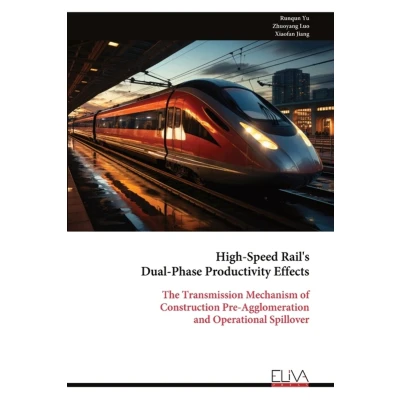
High Speed Rail's Dual Phase Productivity Effects: The Transmission Mechanism of Construction Pre Agglomeration and Operational Spillover
Uitgelicht

|
54,99 |
Naar shop
|
| VERGELIJK ALLE AANBIEDERS (1) | ||
 Beschrijving
Bol
High-speed rail (HSR) serves not merely as a tool for space-time compression but as critical infrastructure that reshapes regional economic geography. Moving beyond the limitations of existing research focused on post-operational economic effects, this book pioneers an "HSR Development Cycle" analytical framework. It reveals the dual-phase dynamic impact mechanism involving pre-agglomeration of resources during the construction phase and factor reallocation during the operational phase, thereby advancing the theoretical construction of the equilibrium mechanism between HSR's "siphon effect" and "diffusion effect". Building on a theoretical breakthrough that proposes a dual-phase "Construction-Operation" model - demonstrating how capital, labor and energy injection during construction triggers structural reorganization of regional factors, thereby subverting the traditional "operation-dominant" paradigm - this research achieves significant methodological advances. These include: creating a capital-labor-energy embedded green Total Factor Productivity (TFP) assessment system integrating weighted non-radial directional distance functions and the Global Malmquist-Luenberger index; developing relative slackness metrics for the construction phase to resolve absolute distance measurement bias; and constructing a neural-network-based counterfactual identification model to precisely isolate net effects amid policy interference. Empirically grounded policy insights emerge from this approach, revealing critical regional heterogeneity in HSR impacts: Eastern China exhibits a "short-term suppression, long-term leap" technological upgrade curve, while central and western regions leverage construction-phase capital dividends for catch-up development. Consequently, this work provides robust, evidence-based zoning strategies for optimizing the planning and implementation of China's "Eight Vertical & Eight Horizontal" HSR network.


Vergelijk aanbieders (1)

 Beschrijving
(1)
Beschrijving
(1)
High-speed rail (HSR) serves not merely as a tool for space-time compression but as critical infrastructure that reshapes regional economic geography. Moving beyond the limitations of existing research focused on post-operational economic effects, this book pioneers an "HSR Development Cycle" analytical framework. It reveals the dual-phase dynamic impact mechanism involving pre-agglomeration of resources during the construction phase and factor reallocation during the operational phase, thereby advancing the theoretical construction of the equilibrium mechanism between HSR's "siphon effect" and "diffusion effect". Building on a theoretical breakthrough that proposes a dual-phase "Construction-Operation" model - demonstrating how capital, labor and energy injection during construction triggers structural reorganization of regional factors, thereby subverting the traditional "operation-dominant" paradigm - this research achieves significant methodological advances. These include: creating a capital-labor-energy embedded green Total Factor Productivity (TFP) assessment system integrating weighted non-radial directional distance functions and the Global Malmquist-Luenberger index; developing relative slackness metrics for the construction phase to resolve absolute distance measurement bias; and constructing a neural-network-based counterfactual identification model to precisely isolate net effects amid policy interference. Empirically grounded policy insights emerge from this approach, revealing critical regional heterogeneity in HSR impacts: Eastern China exhibits a "short-term suppression, long-term leap" technological upgrade curve, while central and western regions leverage construction-phase capital dividends for catch-up development. Consequently, this work provides robust, evidence-based zoning strategies for optimizing the planning and implementation of China's "Eight Vertical & Eight Horizontal" HSR network.
 Productspecificaties
| EAN |
|
|---|---|
| Maat |
|
 Prijshistorie
Prijzen voor het laatst bijgewerkt op:
 Gerelateerde resultaten


