
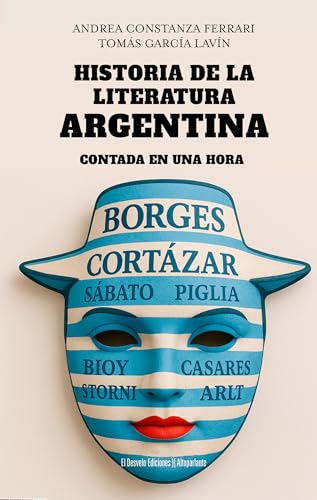
Historia de la literatura argentina contada en una hora: 72
Uitgelicht

|
18,87 |
Naar shop
|

|
18,87 |
Naar shop
|

|
19,00 |
Naar shop
|
| VERGELIJK ALLE AANBIEDERS (3) | ||
 Beschrijving
Bol
This is the first book in a series of literary monographs by country to be published by El Desvelo Ediciones, beginning with this History of Argentine Literature Told in an Hour, following the example of the now classic work that Klabund (Alfred Henschke) wrote about German literature almost 100 years ago. In this case, two profound connoisseurs of Argentine literature, essayists, editors, and translators Tomás García Lavín and Andrea Constanza Ferrari, are in charge of distilling the most outstanding works and authors of literature produced in Argentina or by Argentines, one of the most important in the world. Argentine literature has been one of the most fertile narrative laboratories of the 20th century, combining local tradition and universal experimentation. Its influence on the Spanish language is decisive, having produced authors and works that redefined both the Latin American canon and the horizon of modern Hispanic narrative. Argentina has literary milestones that mark its identity, from Sarmiento with Facundo to Ricardo Piglia, who, with Artificial Respiration, integrated literature, memory, and history under censorship, building a bridge between tradition and contemporary criticism, passing through José Hernández in Martín Fierro and Borges with his Fictions. Argentine literature has milestones that mark its identity and evolution: Sarmiento, with Facundo (1845), founded a political and cultural essay on the opposition between civilization and barbarism; José Hernández, in Martín Fierro (1872-79), turned the gaucho into a national emblem; Leopoldo Lugones, with Lunario sentimental (1909), opened the door to modernist experimentation; Ricardo Güiraldes established the gaucho myth in an elegiac tone in Don Segundo Sombra (1926), Roberto Arlt, with Los siete locos (1929), anticipated the modern urban and existential novel, Borges in Ficciones (1944) revolutionized narrative with metaphysical games, Bioy Casares in La invención de Morel (1940) projected fantasy literature toward science fiction, Cortázar, with Rayuela (1963), broke the mold of the Latin American novel, Manuel Puig, in El beso de la mujer araña (1976), mixed popular culture and political reflection on the dictatorship, and Piglia, with Respiración artificial (1980).


 Beschrijving
(1)
Beschrijving
(1)
This is the first book in a series of literary monographs by country to be published by El Desvelo Ediciones, beginning with this History of Argentine Literature Told in an Hour, following the example of the now classic work that Klabund (Alfred Henschke) wrote about German literature almost 100 years ago. In this case, two profound connoisseurs of Argentine literature, essayists, editors, and translators Tomás García Lavín and Andrea Constanza Ferrari, are in charge of distilling the most outstanding works and authors of literature produced in Argentina or by Argentines, one of the most important in the world. Argentine literature has been one of the most fertile narrative laboratories of the 20th century, combining local tradition and universal experimentation. Its influence on the Spanish language is decisive, having produced authors and works that redefined both the Latin American canon and the horizon of modern Hispanic narrative. Argentina has literary milestones that mark its identity, from Sarmiento with Facundo to Ricardo Piglia, who, with Artificial Respiration, integrated literature, memory, and history under censorship, building a bridge between tradition and contemporary criticism, passing through José Hernández in Martín Fierro and Borges with his Fictions. Argentine literature has milestones that mark its identity and evolution: Sarmiento, with Facundo (1845), founded a political and cultural essay on the opposition between civilization and barbarism; José Hernández, in Martín Fierro (1872-79), turned the gaucho into a national emblem; Leopoldo Lugones, with Lunario sentimental (1909), opened the door to modernist experimentation; Ricardo Güiraldes established the gaucho myth in an elegiac tone in Don Segundo Sombra (1926), Roberto Arlt, with Los siete locos (1929), anticipated the modern urban and existential novel, Borges in Ficciones (1944) revolutionized narrative with metaphysical games, Bioy Casares in La invención de Morel (1940) projected fantasy literature toward science fiction, Cortázar, with Rayuela (1963), broke the mold of the Latin American novel, Manuel Puig, in El beso de la mujer araña (1976), mixed popular culture and political reflection on the dictatorship, and Piglia, with Respiración artificial (1980).
 Productspecificaties
 Prijshistorie
* Prijshistorie bevat geen data van Amazon, Amazon Marketplace.
Prijzen voor het laatst bijgewerkt op:
 Gerelateerde resultaten


