
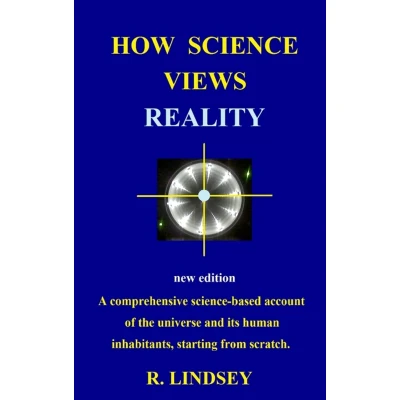
How Science Views Reality: A comprehensive science-based account of the universe and its human inhabitants, starting from scratch.
Uitgelicht

|
32,99 |
Naar shop
|

|
34,80 |
Naar shop
|

|
34,80 |
Naar shop
|
| VERGELIJK ALLE AANBIEDERS (3) | ||
 Beschrijving
Bol
How Science Views Reality is a rigorous construction of the scientific, observation-based case for the nature of reality, and the implications that follow from it. In providing a detailed account of current scientific knowledge in a range of crucial fields, the book is intended also to communicate a frame of mind, an attitude, a feeling of how reality is approached scientifically. To be accessible to as wide an audience as possible, it is written for a lay readership and should be comprehensible to anyone with a modest grasp of high/secondary school science. Starting with some simple, almost trivial observations, the book explains how the basic concepts of science, concepts such as force, mass, energy and laws of nature arise. It then goes on to show that these concepts are equally applicable whatever one is seeking to describe: whether it is the very smallest scales accessible to physics (chapter 3), the universe at large (chapter 4), biological entities (chapter 5), or the human brain (chapter 6). The successful use of scientific concepts to explain not only simple objects like electrons and galaxies, but also enormously complex objects like brains, leads one to wonder: is anything beyond the reach of science? Is reality really no more than a collection of purely material objects obeying the laws that science has revealed? What about consciousness? What about the beliefs we amass as our lives pass, and which guide our behaviour? What about right and wrong? These topics are discussed - to a degree speculatively - in scientific terms in chapters 7, 8 and 9. Finally, in the concluding chapter two ever present components of the human experience of life are explored; namely, the passing of time, and our eternal pondering about the purpose of it all. Overall, the objective of the book is to show how the various key fields of scientific discovery integrate together to form a completely consistent whole. And then to question what this means for the way humans (should?) view the world. Anyone interested in what the physical and biological sciences covered in this book reveal about not only the phenomena we see around us, but also our very selves, will find this book engaging, and possibly challenging. It presents a coherent picture of reality and suggests what this picture means for our understanding of the universe and our place in it.


 Beschrijving
(1)
Beschrijving
(1)
How Science Views Reality is a rigorous construction of the scientific, observation-based case for the nature of reality, and the implications that follow from it. In providing a detailed account of current scientific knowledge in a range of crucial fields, the book is intended also to communicate a frame of mind, an attitude, a feeling of how reality is approached scientifically. To be accessible to as wide an audience as possible, it is written for a lay readership and should be comprehensible to anyone with a modest grasp of high/secondary school science. Starting with some simple, almost trivial observations, the book explains how the basic concepts of science, concepts such as force, mass, energy and laws of nature arise. It then goes on to show that these concepts are equally applicable whatever one is seeking to describe: whether it is the very smallest scales accessible to physics (chapter 3), the universe at large (chapter 4), biological entities (chapter 5), or the human brain (chapter 6). The successful use of scientific concepts to explain not only simple objects like electrons and galaxies, but also enormously complex objects like brains, leads one to wonder: is anything beyond the reach of science? Is reality really no more than a collection of purely material objects obeying the laws that science has revealed? What about consciousness? What about the beliefs we amass as our lives pass, and which guide our behaviour? What about right and wrong? These topics are discussed - to a degree speculatively - in scientific terms in chapters 7, 8 and 9. Finally, in the concluding chapter two ever present components of the human experience of life are explored; namely, the passing of time, and our eternal pondering about the purpose of it all. Overall, the objective of the book is to show how the various key fields of scientific discovery integrate together to form a completely consistent whole. And then to question what this means for the way humans (should?) view the world. Anyone interested in what the physical and biological sciences covered in this book reveal about not only the phenomena we see around us, but also our very selves, will find this book engaging, and possibly challenging. It presents a coherent picture of reality and suggests what this picture means for our understanding of the universe and our place in it.
 Productspecificaties
 Prijshistorie
* Prijshistorie bevat geen data van Amazon, Amazon Marketplace.
Prijzen voor het laatst bijgewerkt op:
 Gerelateerde resultaten


