


€ 92,99 Gratis verzending

Uitgelicht
|
|
92,99 |
Naar shop
|

|
100,70 |
Naar shop
|
| VERGELIJK ALLE AANBIEDERS (2) | ||
 Beschrijving
Vergelijk aanbieders (2)
€ 92,99 Gratis verzending
€ 100,70 Gratis verzending
Winkels met andere maten
Beschrijving
(1)
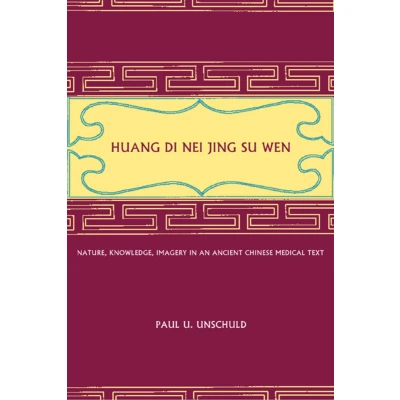
A text of Chinese medicine that helps to better understand the roots of Chinese medicine as an integrated aspect of Chinese civilization. It contains discussions about the differences and parallels between European and Chinese ways of dealing with illness and the risk of early death. "The essential reference for ancient Chinese medicine."—Donald Harper, University of Chicago "The Huang Di nei jing su wen", known familiarly as the "Su wen", is a seminal text of ancient Chinese medicine, yet until now there has been no comprehensive, detailed analysis of its development and contents. At last Paul U. Unschuld offers entry into this still - vital artifact of China's cultural and intellectual past. Unschuld traces the history of the "Su wen" to its origins in the final centuries B.C.E., when numerous authors wrote short medical essays to explain the foundations of human health and illness on the basis of the newly developed vessel theory. He examines the meaning of the title and the way the work has been received throughout Chinese medical history, both before and after the eleventh century when the text as it is known today emerged. Unschuld's survey of the contents includes illuminating discussions of the yin-yang and five-agents doctrines, the perception of the human body and its organs, qi and blood, pathogenic agents, concepts of disease and diagnosis, and a variety of therapies, including the new technique of acupuncture. An extensive appendix, furthermore, offers a detailed introduction to the complicated climatological theories of Wu yun liu qi ('five periods and six qi'), which were added to the "Su wen" by Wang Bing in the Tang era. In an epilogue, Unschuld writes about the break with tradition and innovative style of thought represented by the "Su wen". For the first time, health care took the form of 'medicine', in that it focused on environmental conditions, climatic agents, and behavior as causal in the emergence of disease and on the importance of natural laws in explaining illness. Unschuld points out that much of what we surmise about the human organism is simply a projection, reflecting dominant values and social goals, and he constructs a hypothesis to explain the formation and acceptance of basic notions of health and disease in a given society. Reading the "Su wen", he says, not only offers a better understanding of the roots of Chinese medicine as an integrated aspect of Chinese civilization; it also provides a much needed starting point for discussions of the differences and parallels between European and Chinese ways of dealing with illness and the risk of early death.
 Prijshistorie
 * Prijshistorie bevat geen data van Amazon.
Prijzen voor het laatst bijgewerkt op:
 Gerelateerde resultaten
 Productspecificaties


