
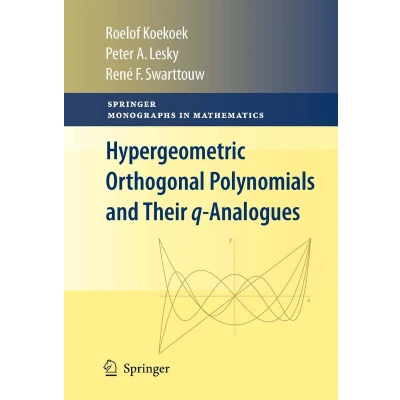
Hypergeometric Orthogonal Polynomials and Their q Analogues
Uitgelicht

|
146,00 |
Naar shop
|
| VERGELIJK ALLE AANBIEDERS (1) | ||
 Beschrijving
Bol
In fact, they have properties so similar that I am inclined (f- lowing Andrews & Askey [34]) to call all families in the (q-)Askey scheme classical orthogonal polynomials, and to call the Jacobi, Laguerre and Hermite polynomials very classical orthogonal polynomials. The very classical orthogonal polynomials named after Hermite, Laguerre and Jacobi, satisfy many common properties. For instance, they satisfy a second-order differential equation with polynomial coefficients and they can be expressed in terms of a hypergeometric function. Replacing the differential equation by a second-order difference equation results in (discrete) orthogonal polynomial solutions with similar properties. Generalizations of these difference equations, in terms of Hahn's q-difference operator, lead to both continuous and discrete orthogonal polynomials with similar properties. For instance, they can be expressed in terms of (basic) hypergeometric functions. Based on Favard's theorem, the authors first classify all families of orthogonal polynomials satisfying a second-order differential or difference equation with polynomial coefficients. Together with the concept of duality this leads to the families of hypergeometric orthogonal polynomials belonging to the Askey scheme. For each family they list the most important properties and they indicate the (limit) relations. Furthermore the authors classify all q-orthogonal polynomials satisfying a second-order q-difference equation based on Hahn's q-operator. Together with the concept of duality this leads to the families of basic hypergeometric orthogonal polynomials which can be arranged in a q-analogue of the Askey scheme. Again, for each family they list the most important properties, the (limit) relations between the various families and the limit relations (for q --> 1) to the classical hypergeometric orthogonal polynomials belonging to the Askey scheme. These (basic) hypergeometric orthogonal polynomials have several applications in various areas of mathematics and (quantum) physics such as approximation theory, asymptotics, birth and death processes, probability and statistics, coding theory and combinatorics. The present book is about the Askey scheme and the q-Askey scheme, which are graphically displayed right before chapter 9 and chapter 14, respectively. The fa- lies of orthogonal polynomials in these two schemes generalize the classical orth- onal polynomials (Jacobi, Laguerre and Hermite polynomials) and they have pr- erties similar to them. In fact, they have properties so similar that I am inclined (f- lowing Andrews & Askey [34]) to call all families in the (q-)Askey scheme classical orthogonal polynomials, and to call the Jacobi, Laguerre and Hermite polynomials very classical orthogonal polynomials. These very classical orthogonal polynomials are good friends of mine since - most the beginning of my mathematical career. When I was a fresh PhD student at the Mathematical Centre (now CWI) in Amsterdam, Dick Askey spent a sabbatical there during the academic year 1969–1970. He lectured to us in a very stimulating wayabouthypergeometricfunctionsandclassicalorthogonalpolynomials. Evenb- ter, he gave us problems to solve which might be worth a PhD. He also pointed out to us that there was more than just Jacobi, Laguerre and Hermite polynomials, for instance Hahn polynomials, and that it was one of the merits of the Higher Transc- dental Functions (Bateman project) that it included some newer stuff like the Hahn polynomials (see [198, §10. 23]).


Vergelijk aanbieders (1)

 Beschrijving
(1)
Beschrijving
(1)
In fact, they have properties so similar that I am inclined (f- lowing Andrews & Askey [34]) to call all families in the (q-)Askey scheme classical orthogonal polynomials, and to call the Jacobi, Laguerre and Hermite polynomials very classical orthogonal polynomials. The very classical orthogonal polynomials named after Hermite, Laguerre and Jacobi, satisfy many common properties. For instance, they satisfy a second-order differential equation with polynomial coefficients and they can be expressed in terms of a hypergeometric function. Replacing the differential equation by a second-order difference equation results in (discrete) orthogonal polynomial solutions with similar properties. Generalizations of these difference equations, in terms of Hahn's q-difference operator, lead to both continuous and discrete orthogonal polynomials with similar properties. For instance, they can be expressed in terms of (basic) hypergeometric functions. Based on Favard's theorem, the authors first classify all families of orthogonal polynomials satisfying a second-order differential or difference equation with polynomial coefficients. Together with the concept of duality this leads to the families of hypergeometric orthogonal polynomials belonging to the Askey scheme. For each family they list the most important properties and they indicate the (limit) relations. Furthermore the authors classify all q-orthogonal polynomials satisfying a second-order q-difference equation based on Hahn's q-operator. Together with the concept of duality this leads to the families of basic hypergeometric orthogonal polynomials which can be arranged in a q-analogue of the Askey scheme. Again, for each family they list the most important properties, the (limit) relations between the various families and the limit relations (for q --> 1) to the classical hypergeometric orthogonal polynomials belonging to the Askey scheme. These (basic) hypergeometric orthogonal polynomials have several applications in various areas of mathematics and (quantum) physics such as approximation theory, asymptotics, birth and death processes, probability and statistics, coding theory and combinatorics. The present book is about the Askey scheme and the q-Askey scheme, which are graphically displayed right before chapter 9 and chapter 14, respectively. The fa- lies of orthogonal polynomials in these two schemes generalize the classical orth- onal polynomials (Jacobi, Laguerre and Hermite polynomials) and they have pr- erties similar to them. In fact, they have properties so similar that I am inclined (f- lowing Andrews & Askey [34]) to call all families in the (q-)Askey scheme classical orthogonal polynomials, and to call the Jacobi, Laguerre and Hermite polynomials very classical orthogonal polynomials. These very classical orthogonal polynomials are good friends of mine since - most the beginning of my mathematical career. When I was a fresh PhD student at the Mathematical Centre (now CWI) in Amsterdam, Dick Askey spent a sabbatical there during the academic year 1969–1970. He lectured to us in a very stimulating wayabouthypergeometricfunctionsandclassicalorthogonalpolynomials. Evenb- ter, he gave us problems to solve which might be worth a PhD. He also pointed out to us that there was more than just Jacobi, Laguerre and Hermite polynomials, for instance Hahn polynomials, and that it was one of the merits of the Higher Transc- dental Functions (Bateman project) that it included some newer stuff like the Hahn polynomials (see [198, §10. 23]).
 Productspecificaties
| EAN |
|
|---|---|
| Maat |
|
 Prijshistorie
Prijzen voor het laatst bijgewerkt op:
 Gerelateerde resultaten


