
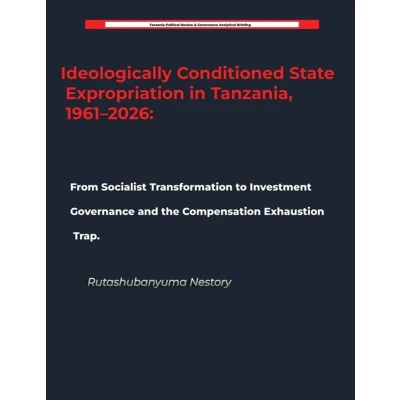
Ideologically Conditioned State Expropriation in Tanzania, 1961-2026 From Socialist Transformation to Investment Governance and the Compensation Exhaustion Trap
Uitgelicht

|
24,93 |
Naar shop
|

|
58,50 |
Naar shop
|
| VERGELIJK ALLE AANBIEDERS (2) | ||
 Beschrijving
Bol
Ideologically Conditioned State Expropriation in Tanzania, 1961-2026 From Socialist Transformation to Investment Governance and the Compensation Exhaustion TrapWhy has compulsory land acquisition in Tanzania remained a persistent feature of governance despite dramatic ideological shifts from African socialism to market-oriented economic liberalization?This book offers a new theoretical explanation. Challenging conventional accounts that treat expropriation as merely a legal or administrative process, it argues that compulsory acquisition has consistently been shaped by the state's prevailing ideological priorities. Whether driven by socialist nation-building or investment-led development, expropriation has functioned as a strategic instrument through which governments pursue broader political and economic objectives.Developing the original theory of Ideologically Conditioned State Expropriation (ICSE), the book demonstrates how changing state ideologies redefine the purposes, methods, and justifications of compulsory acquisition while preserving the state's central authority over land. It further introduces the concept of the Compensation Exhaustion Trap (CET), explaining why financial compensation alone frequently fails to restore livelihoods, social stability, or long-term economic security for displaced communities. The book also advances the Benefit Sharing and Livelihood Guarantee Framework (BSLGF) as a practical governance model for reconciling national development with social justice.Drawing on constitutional principles, statutory law, judicial decisions, policy documents, and six decades of historical evidence, this study traces the evolution of Tanzania's expropriation regime from independence in 1961 through the socialist villagization era, structural adjustment, investment liberalization, and contemporary infrastructure-driven development.Bridging law, political economy, governance, and development studies, this work makes an important contribution to debates on property rights, land governance, state power, and equitable development. It offers scholars, policymakers, legal practitioners, investors, and development professionals a comprehensive framework for understanding why expropriation persists, how its rationale evolves, and what reforms are necessary to ensure that development does not come at the irreversible expense of those who surrender their land.


 Beschrijving
(1)
Beschrijving
(1)
Ideologically Conditioned State Expropriation in Tanzania, 1961-2026 From Socialist Transformation to Investment Governance and the Compensation Exhaustion TrapWhy has compulsory land acquisition in Tanzania remained a persistent feature of governance despite dramatic ideological shifts from African socialism to market-oriented economic liberalization?This book offers a new theoretical explanation. Challenging conventional accounts that treat expropriation as merely a legal or administrative process, it argues that compulsory acquisition has consistently been shaped by the state's prevailing ideological priorities. Whether driven by socialist nation-building or investment-led development, expropriation has functioned as a strategic instrument through which governments pursue broader political and economic objectives.Developing the original theory of Ideologically Conditioned State Expropriation (ICSE), the book demonstrates how changing state ideologies redefine the purposes, methods, and justifications of compulsory acquisition while preserving the state's central authority over land. It further introduces the concept of the Compensation Exhaustion Trap (CET), explaining why financial compensation alone frequently fails to restore livelihoods, social stability, or long-term economic security for displaced communities. The book also advances the Benefit Sharing and Livelihood Guarantee Framework (BSLGF) as a practical governance model for reconciling national development with social justice.Drawing on constitutional principles, statutory law, judicial decisions, policy documents, and six decades of historical evidence, this study traces the evolution of Tanzania's expropriation regime from independence in 1961 through the socialist villagization era, structural adjustment, investment liberalization, and contemporary infrastructure-driven development.Bridging law, political economy, governance, and development studies, this work makes an important contribution to debates on property rights, land governance, state power, and equitable development. It offers scholars, policymakers, legal practitioners, investors, and development professionals a comprehensive framework for understanding why expropriation persists, how its rationale evolves, and what reforms are necessary to ensure that development does not come at the irreversible expense of those who surrender their land.
 Productspecificaties
 Prijshistorie
* Prijshistorie bevat geen data van Amazon.
Prijzen voor het laatst bijgewerkt op:
 Gerelateerde resultaten


