


€ 26,99 Gratis verzending

Uitgelicht
|
|
26,99 |
Naar shop
|
| VERGELIJK ALLE AANBIEDERS (1) | ||
 Beschrijving
Vergelijk aanbieders (1)
€ 26,99 Gratis verzending
Winkels met andere maten
Beschrijving
(1)
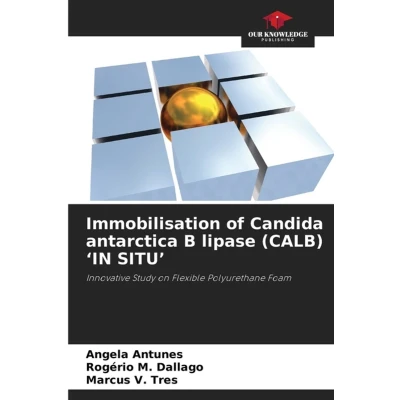
This book aims to evaluate the process of immobilising Candida antarctica B (CAL B) lipase in flexible polyurethane. The enzyme polymerisation process was carried out by mixing monomers, surfactants, chain extenders and water. The immobilisation technique, as well as the stability of the immobilised enzyme at different temperatures and the capacity for reaction cycles, were evaluated by the synthesis activity of oleic acid and ethanol. In order to optimise the process of measuring the esterification activity of immobilised D30 and D18, a central composite rotational design (CCRD) was performed using enzyme concentration and reaction temperature as variables. The results of continuous recycling demonstrated the possibility of reusing immobilised D30 and D18 up to 5 times, considering 50% residual activity. The results of the recycling carried out every 24 hours and with washing in organic solvents showed reuse up to 15 times for both immobilised enzymes (D30 and D18). Regarding the thermal stability of the immobilised enzymes, the results were superior to those presented by free Candida antactica B lipase.
 Productspecificaties
| EAN |
|
|---|---|
| Maat |
|
 Prijshistorie
 Prijzen voor het laatst bijgewerkt op:
 Gerelateerde resultaten


